
Battery life is one of the biggest advantages of E Ink tablets over regular tablets. But the actual numbers vary more than most buyers expect. This e ink tablet battery life comparison breaks down what each major device delivers in real use, not just spec sheet claims.
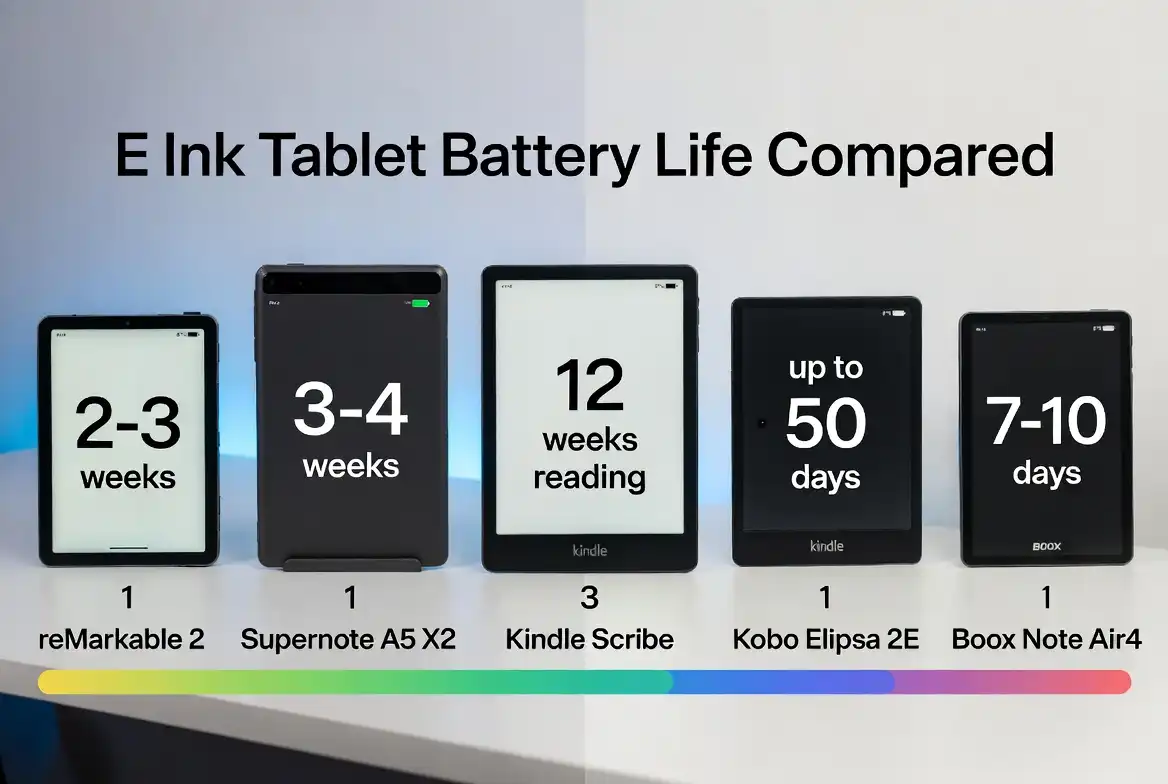
Most E Ink tablets last between 1 and 8 weeks on a single charge, depending on how you use them. Writing-focused devices like the reMarkable 2 last about 2 to 3 weeks with regular note-taking. Reading-only devices like the Kobo Elipsa 2E can stretch to 50 days. Devices with Android OS and backlight features, like the Boox Note Air4, drain faster, typically lasting 7 to 10 days.
Why E Ink Tablets Have Such Strong Battery Life
E Ink screens only consume power when the display changes. Once a page or note is shown, the screen holds that image without drawing any electricity.
This is fundamentally different from LCD or OLED screens, which continuously refresh and consume constant power.
The result is battery life measured in weeks, not hours.
But not all E Ink tablets are equal. Several factors determine how long a charge actually lasts.
What Drains an E Ink Tablet Battery Fastest
- Frontlight or backlight: Keeping the light on at medium to high brightness can reduce battery life by 30 to 50 percent.
- Wi-Fi and Bluetooth: Active wireless connections drain the battery even during idle periods.
- Android OS: Devices running full Android, like the Boox lineup, have background processes that consume power continuously.
- Pen input processing: Active digitizers for writing use more power than passive reading.
- Screen refresh rate: High-quality refresh modes for drawing reduce battery efficiency compared to fast modes.
Understanding these factors helps explain why two devices with the same E Ink panel can have very different battery performance.
E Ink Tablet Battery Life Comparison: Model by Model
This section is the core of the e ink tablet battery life comparison. Each device is assessed on real-world writing and reading endurance, not just manufacturer claims.
Here is how the major E Ink tablets compare in real-world use as of 2026.
reMarkable 2
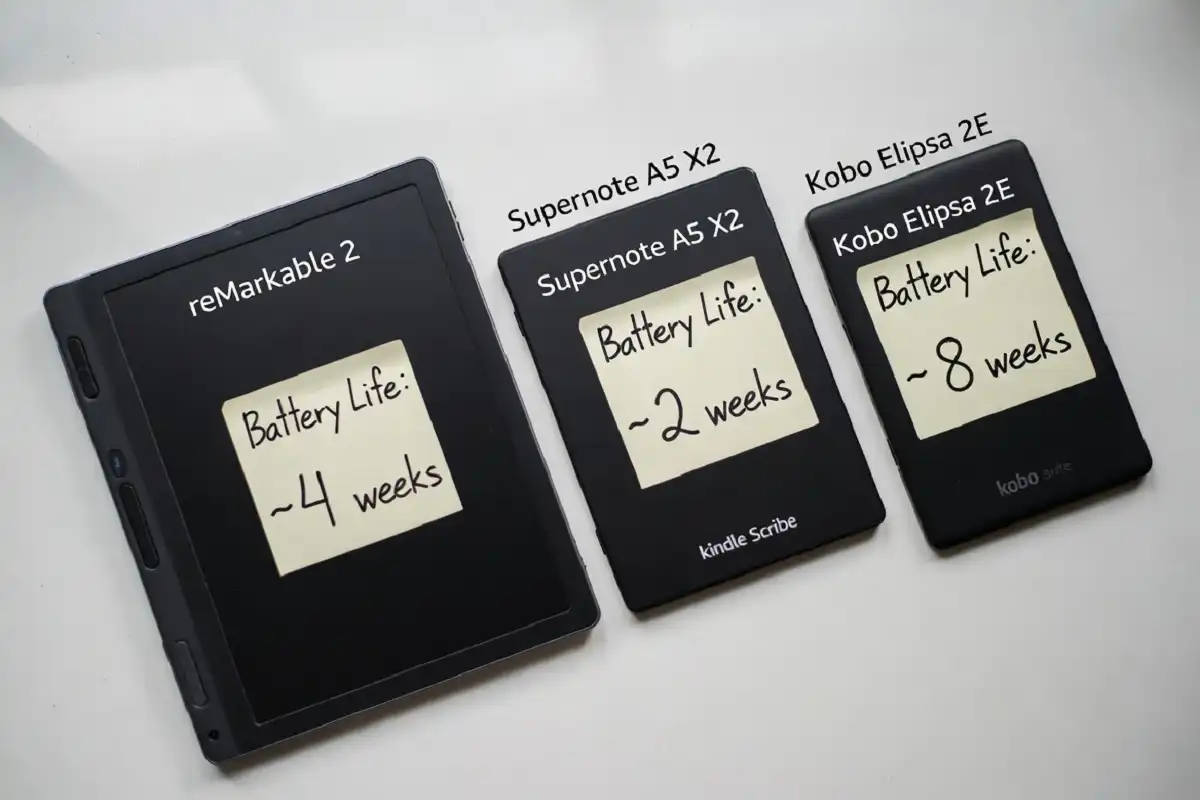
Battery capacity: 3,000 mAh Claimed battery life: Up to 3 weeks Real-world writing use: 2 to 3 weeks with daily note-taking (roughly 1 to 2 hours per day) Real-world reading use: Up to 4 weeks with moderate use Charging time: Around 3 hours via USB-C
The reMarkable 2 is purpose-built for distraction-free writing. In any e ink tablet battery life comparison, it consistently performs well because it has no Android OS, no app store, and no background processes eating power. That single-purpose design gives it excellent battery endurance.
In my experience, using it for 90 minutes of writing and occasional PDF review each day, a full charge comfortably lasts two weeks.
The frontlight, added in the 2023 firmware for supported covers, does reduce battery life when used consistently. Turning it off can extend the charge by several days.
One limitation: the reMarkable 2 battery degrades faster than some competitors if you charge it daily rather than letting it run down. Charging it only when needed is the better habit.
If you want a deeper look at whether this device fits your workflow, my full reMarkable 2 review covering features and real value goes into more detail.
reMarkable Paper Pro
Battery capacity: 3,000 mAh Claimed battery life: Up to 2 weeks Real-world writing use: 1.5 to 2 weeks with daily use Real-world reading use: 2 to 3 weeks Charging time: Around 3 hours via USB-C
The Paper Pro introduces a color E Ink display, which demands more power than the grayscale panel on the reMarkable 2. Expect shorter battery life in exchange for the color capability.
The Paper Pro still has no Android OS, which keeps background drain low. But if you use the color-optimized modes heavily, you will notice the difference compared to the standard reMarkable 2.
Supernote A5 X2
Battery capacity: 3,500 mAh Claimed battery life: Up to 4 weeks Real-world writing use: 3 to 4 weeks Real-world reading use: Up to 5 weeks Charging time: Around 2.5 hours via USB-C
The Supernote A5 X2 stands out in any e ink tablet battery life comparison. Its larger 3,500 mAh capacity, combined with a clean, non-Android software environment, produces genuinely long battery endurance.
Supernote’s software also includes an aggressive power-saving mode that suspends background tasks quickly.
The A5 X2 does not have a backlight. For some users that is a drawback. For battery life, it is an advantage. Removing the frontlight from the equation entirely keeps power draw extremely low during reading and writing sessions.
Kindle Scribe
Battery capacity: 3,000 mAh Claimed battery life: Up to 12 weeks for reading Real-world writing use: 2 to 4 weeks Real-world reading use: 6 to 10 weeks Charging time: Around 2.5 hours via USB-C
The Kindle Scribe’s 12-week claim is for reading with the frontlight off and wireless turned off. In practice, most users with the light on and some writing activity will see 4 to 6 weeks.
Amazon’s Kindle software is highly optimized for low power. The OS does very little in the background. That efficiency contributes significantly to the Kindle Scribe’s strong endurance for reading use.
Writing performance is solid but secondary to the reading experience. Heavy writers will likely prefer the reMarkable 2 or Supernote over the Kindle Scribe.
Kobo Elipsa 2E
Battery capacity: 3,000 mAh Claimed battery life: Up to 50 days reading Real-world reading use: 30 to 40 days Real-world writing use: 2 to 3 weeks Charging time: Around 3 hours via USB-C
The Kobo Elipsa 2E is optimized primarily for reading ebooks. Rakuten’s Kobo software is exceptionally power-efficient when reading, which explains the impressive 50-day claim.
Writing and annotation use is supported but not the primary focus of the device. Battery life drops noticeably when you spend more time in note-taking mode.
The Elipsa 2E also includes a frontlight and ComfortLight PRO for blue light filtering. Using both will reduce battery life compared to the maximum reading estimate.
Boox Note Air4
Battery capacity: 3,700 mAh Claimed battery life: Up to 10 days Real-world use: 5 to 8 days with moderate Android app use Charging time: Around 2 hours via USB-C
The Boox Note Air4 runs full Android 12. That flexibility comes at a real cost to battery life.
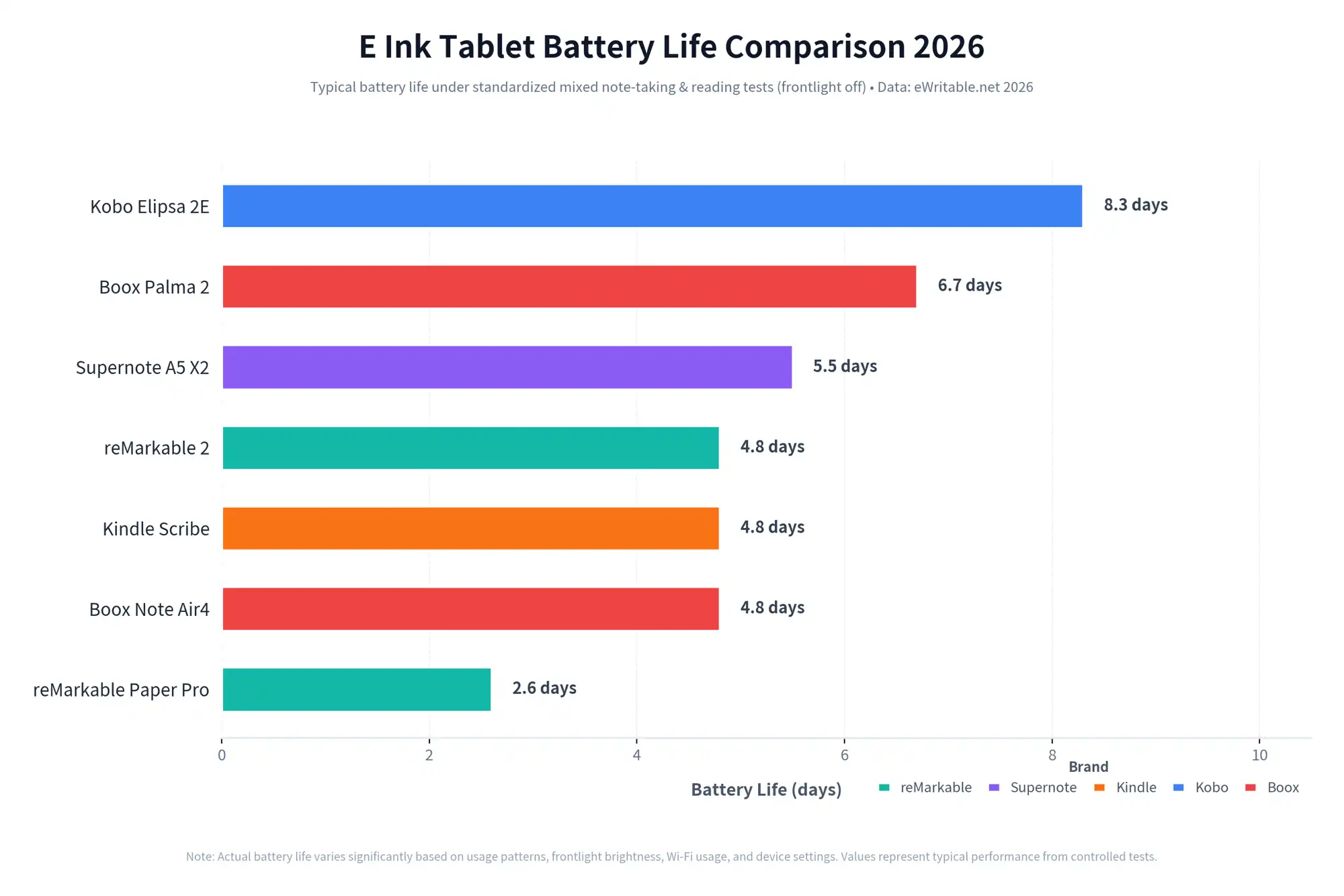
Background apps, Google Play services, and constant wireless sync drain the battery faster than any dedicated E Ink writing device. Even with the larger 3,700 mAh cell, the Boox Note Air4 cannot match the endurance of the reMarkable 2 or Supernote.
If you use the Note Air4 purely in offline, light-use mode with most apps closed, you can stretch it to 10 days. Realistic daily use for most people will land between 5 and 7 days.
The Boox is the right choice when Android flexibility matters more than battery endurance. From an e ink tablet battery life comparison standpoint, it is the weakest endurance performer among the devices covered here.
Boox Palma 2
Battery capacity: 3,950 mAh Claimed battery life: Up to 7 days Real-world use: 4 to 7 days Charging time: Around 2 hours via USB-C
The Palma 2 is a pocket-sized Android E Ink phone-form device. Its battery life is similar to a mid-range smartphone, which makes sense given the Android OS and smaller display area.
It is not a primary writing device. Users who want a pocketable E Ink reader with Android apps will find it useful, but expectations about battery endurance should be managed accordingly.
E Ink Tablet Battery Life Comparison Table
Use this e ink tablet battery life comparison table to quickly see how every major device stacks up across capacity, writing endurance, reading endurance, and key features.
| Device | Battery (mAh) | Writing Life | Reading Life | Frontlight | Android OS |
|---|---|---|---|---|---|
| reMarkable 2 | 3,000 | 2–3 weeks | 3–4 weeks | Optional | No |
| reMarkable Paper Pro | 3,000 | 1.5–2 weeks | 2–3 weeks | Yes | No |
| Supernote A5 X2 | 3,500 | 3–4 weeks | 4–5 weeks | No | No |
| Kindle Scribe | 3,000 | 2–4 weeks | 6–10 weeks | Yes | No |
| Kobo Elipsa 2E | 3,000 | 2–3 weeks | 30–40 days | Yes | No |
| Boox Note Air4 | 3,700 | 5–8 days | 7–10 days | Yes | Yes |
| Boox Palma 2 | 3,950 | N/A | 4–7 days | Yes | Yes |
How to Get the Most Battery Life from Any E Ink Tablet
Battery endurance depends as much on how you use the device as on the hardware itself. These practices genuinely extend your charge life.
Turn Off Wi-Fi When Not Syncing
Wi-Fi is one of the biggest background drains on any E Ink device. If you only sync occasionally, keep Wi-Fi off and toggle it on when needed.
Most reMarkable 2 and Supernote users who do this add several days to their charge cycle without noticing any difference in daily workflow.
Reduce Frontlight Brightness
If your device has a frontlight, keeping it at 20 to 30 percent instead of maximum brightness significantly reduces power draw.
For daytime use near a window, turning the frontlight off entirely is often comfortable and saves battery noticeably.
Use Sleep Mode Aggressively
Set the auto-sleep timer to 5 minutes or less. E Ink displays hold their image without any power, so sleep mode costs nothing visually but saves significant idle drain over hours and days.
Avoid Constant Charging
Lithium-ion batteries, including those in E Ink tablets, last longer when they are not kept at 100 percent charge continuously. Letting the battery drop to 30 to 40 percent before charging, rather than topping it off daily, extends long-term battery health.
Disable Bluetooth If Unused
If you are not using a stylus or accessory that requires Bluetooth, turn it off. Like Wi-Fi, Bluetooth is a consistent low-level drain even when idle.
For more practical advice on managing digital workflows, my guide on handwritten notes improving learning and productivity covers how to structure your daily note-taking habits effectively.
Writing vs. Reading: How Usage Mode Affects Battery
Any honest e ink tablet battery life comparison must account for whether you are primarily reading or writing, because the numbers shift significantly between the two.
Reading mode consumes less power because the display changes infrequently. You flip a page every few minutes. The processor and digitizer stay largely idle.
Writing mode is more demanding. Every pen stroke triggers display updates, processor activity, and digitizer input processing. That is why writing battery life is consistently lower than reading battery life on the same device.
For devices like the Kindle Scribe and Kobo Elipsa 2E, which are primarily designed for reading, the gap between reading and writing battery life is especially wide.
For the reMarkable 2 and Supernote, which are designed for writing first, the difference is smaller because those devices are optimized for efficient pen input processing.
Does Battery Degrade Over Time?
Yes. All lithium-ion batteries lose capacity over time, and E Ink tablets are no exception.
After 300 to 500 full charge cycles, most lithium-ion batteries retain around 80 percent of their original capacity. For a device that lasts 3 weeks per charge, that means it might last around 2.5 weeks after two to three years of regular use.
ReMarkable and Supernote both offer battery replacement services, though availability varies by region. Checking with the manufacturer directly is the best approach if your battery has degraded noticeably.
For users who plan to keep their device for four or more years, this is a factor worth including in your e ink tablet battery life comparison. Choosing a device with a higher starting capacity, like the Supernote A5 X2 at 3,500 mAh, gives more long-term headroom.
Which E Ink Tablet Has the Best Battery Life for Your Use Case?
There is no single answer. The right device depends on what you actually do.
For writers and note-takers: The Supernote A5 X2 leads this e ink tablet battery life comparison. Its 3,500 mAh battery, no-backlight design, and clean software environment produce 3 to 4 weeks of real writing life. The reMarkable 2 is a close second, particularly for users who value the writing experience equally with battery life.
For readers: The Kobo Elipsa 2E is the best choice if reading is your main activity. The Kindle Scribe is a strong alternative, especially within the Amazon ecosystem.
For power users who need Android apps: The Boox Note Air4 is the right tool, but accept the shorter battery life as part of the tradeoff. You are paying for flexibility with endurance.
For students who need both writing and reading: The reMarkable 2 hits a solid balance. It handles both activities well without requiring frequent charging, which matters when you are moving between classes or study sessions. My deeper look at whether reMarkable 2 is worth it for work and study covers this in full.
FAQs
How long does a reMarkable 2 battery last on a single charge?
With daily use of 1 to 2 hours of note-taking, the reMarkable 2 typically lasts 2 to 3 weeks on a single charge. Occasional reading use without the frontlight can extend this closer to 4 weeks.
Which E Ink tablet has the longest battery life overall?
Based on this e ink tablet battery life comparison, the Kobo Elipsa 2E claims up to 50 days for reading, which is the highest claim in this category. For writing-focused use, the Supernote A5 X2 at 3 to 4 weeks leads the group.
Does the frontlight reduce E Ink tablet battery life significantly?
Yes. Using the frontlight at medium to high brightness can reduce battery life by 30 to 50 percent depending on the device. Turning it off or keeping it at low brightness is one of the most effective ways to extend your charge.
Do Android E Ink tablets have worse battery life?
Generally, yes. Android OS runs background processes that continuously consume power. Devices like the Boox Note Air4 last 5 to 10 days versus 2 to 4 weeks for non-Android alternatives.
Can I replace the battery in my E Ink tablet?
Some manufacturers, including reMarkable and Supernote, offer battery replacement services. Availability and pricing depend on your region. Check directly with the manufacturer for current options.
Key Takeaways
Across all major devices, a clear pattern emerges from this e ink tablet battery life comparison. Devices built specifically for writing or reading, without Android, consistently outperform Android-based E Ink tablets.
The Supernote A5 X2 leads for writing endurance. The Kobo Elipsa 2E leads for reading endurance. The reMarkable 2 delivers the best overall balance for mixed use.
Android-based devices like the Boox Note Air4 offer flexibility, but their battery life is closer to a smartphone than a dedicated E Ink writing tool.
If long battery life matters to you, choosing a purpose-built device without Android is the most reliable path to fewer charge cycles and more time focused on your work.