
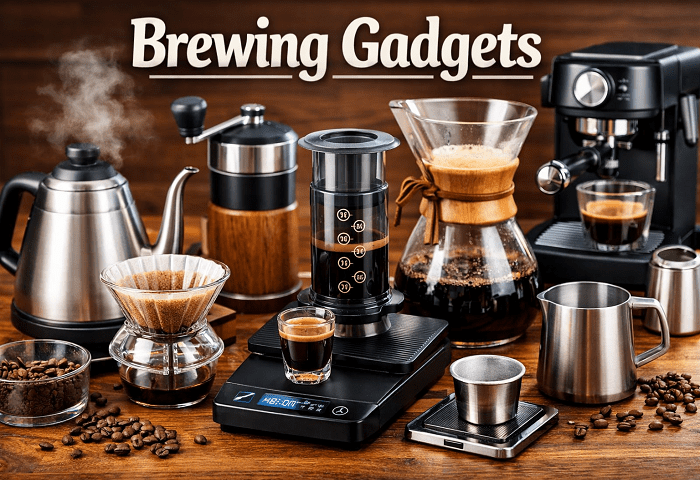
Introduction
There’s something quietly magical about the first sip of coffee you’ve brewed yourself, especially when the water hits the grounds at just the right moment and the kitchen fills with that warm, nutty aroma. For years I used a basic drip machine and called it good. Then a friend handed me a freshly ground pour-over one rainy Saturday morning, and I realized I’d been missing out on an entire world. That world, as it turns out, runs on good beans and the right brewing gadgets.
If you’ve been curious about leveling up your coffee at home but feel overwhelmed by the sheer number of tools on the market, you’re in good company. Walk into any specialty coffee shop and you’ll see a countertop packed with shiny equipment. Browse online and the options multiply into the hundreds. This guide is meant to cut through that noise. We’ll look at which brewing gadgets genuinely make a difference, which ones are fun extras, and how to build a setup that matches your taste, your budget, and your morning routine.
Why the Right Brewing Gadgets Actually Matter
Before diving into specific tools, it’s worth pausing on the “why.” Coffee is deceptively simple on paper: hot water, ground beans, a filter of some kind. Yet anyone who’s taken two identical bags of beans and brewed them with different equipment knows the cup can taste wildly different. That variation comes down to grind size, water temperature, contact time, and the ratio of coffee to water. The right brewing gadgets give you control over those variables so you can repeat a good cup or tweak a bad one.
Good coffee equipment also tends to last. A quality burr grinder can easily run ten years or more with basic maintenance. A well-built gooseneck kettle might outlive two or three kitchen renovations. When people say brewing gadgets are an investment, they’re not being dramatic. Buy thoughtfully once and you rarely have to shop again.
There’s also the ritual side, which I think deserves more credit than it gets. The small, focused motions of weighing, pouring, and tasting slow you down in a way that feels genuinely good. On busy weekday mornings, a minute or two with your favorite brewing gadgets can set a calmer tone for the whole day.
The Grinder: Where Everything Begins
If I could only recommend one upgrade for someone new to home brewing, it would be a burr grinder. Blade grinders chop beans unevenly, producing a mix of dust and boulders that brews inconsistently. Burr grinders crush beans between two ridged discs, giving you uniform particles and, therefore, uniform extraction.
You’ll hear people debate flat burrs versus conical burrs endlessly online. For most home setups, either will do a wonderful job. What matters more is stepping up from a blade grinder to any burr grinder at all. Manual hand grinders are a fantastic entry point because they’re affordable, quiet, and surprisingly capable. Electric models save time if you’re brewing for multiple people or making espresso, where a fine, consistent grind is non-negotiable.
Pay attention to the grind range. Some brewing gadgets in this category excel at medium grinds for pour-over and French press but struggle with espresso-fine particles. Others go the opposite way. If you plan to experiment across brewing methods, look for a grinder with a wide adjustment range and stepless or micro-step settings.
Clean your grinder regularly. Old coffee oils go rancid and can muddy the flavor of fresh beans. A small brush and an occasional deep clean with grinder-cleaning tablets will keep it running sweetly.
Scales and Timers: The Unsexy Heroes
A digital scale is arguably the most underrated member of the brewing gadgets family. For under fifty dollars you can buy a coffee scale that measures to one-tenth of a gram and includes a built-in timer. This small device turns guessing into measuring and transforms your brewing from “hope it tastes okay” into a repeatable process.
The golden ratio for most filter coffee sits somewhere between 1:15 and 1:17, meaning one gram of coffee for every fifteen to seventeen grams of water. Eyeballing tablespoons will never get you there reliably. A scale will. Once you start weighing your dose and your water, you gain a vocabulary for what works: a 20-gram dose with 320 grams of water at three-and-a-half minutes, for example, becomes a recipe you can adjust rather than a mystery you can’t reproduce.
Timers matter too. Extraction time dictates how much flavor pulls from the grounds. Too short and your coffee tastes sour and underdeveloped. Too long and it turns bitter and harsh. Brewing gadgets with integrated timers simplify this enormously. Many modern scales ship with Bluetooth connectivity and companion apps that log your brews, though honestly, a basic model with a stopwatch button will serve you just fine.
Kettles Worth Your Counter Space
The kettle you use affects temperature and pour control, both of which have a direct impact on flavor. For pour-over specifically, a gooseneck kettle is a genuine game-changer. The long, narrow spout lets you pour a thin, controlled stream exactly where you want it, which matters when you’re saturating grounds evenly.
Variable-temperature electric kettles take things further by letting you dial in a specific temperature. The sweet spot for most coffee sits between 195 and 205 degrees Fahrenheit, or roughly 90 to 96 Celsius. Darker roasts often shine at the lower end of that range, while lighter roasts benefit from hotter water that pulls more out of the beans. Without a thermometer built in, you’re guessing, and guessing is the enemy of a great cup.
Stovetop gooseneck kettles are a solid middle ground if you prefer a simpler kitchen. They require more attention but cost less and take up less space. Whatever style you choose, look for a comfortable handle, a balanced pour, and a capacity that matches how many cups you typically make at once. Among all the brewing gadgets on your counter, the kettle is the one you’ll physically handle most, so ergonomics matter more than you’d think.
Pour-Over Devices: Simple, Elegant, Precise
Pour-over brewers are some of the most beloved brewing gadgets among specialty coffee fans, and for good reason. They’re inexpensive, easy to master, and produce a clean, nuanced cup that showcases the character of good beans.
The Hario V60 is probably the most famous of the bunch. Its conical shape, spiral ridges, and single large drainage hole give you a lot of control over flow rate. Change your grind or your pour technique and the cup changes with you. The Chemex, with its iconic hourglass silhouette and thicker filters, produces a brighter, tea-like cup with very little sediment. The Kalita Wave, a flat-bottom dripper with three small holes, is more forgiving and tends to produce consistent results even when your pour isn’t perfect.
Each of these brewing gadgets has its own flavor signature. I keep a V60 and a Kalita Wave in my kitchen and reach for them depending on the beans and my mood. Lighter, fruitier beans often sing in the V60. Balanced, chocolatey roasts taste rich and round in the Kalita.
Don’t forget about filters. Bleached and unbleached papers brew differently, as do metal mesh filters, which let more oils through and produce a heavier body. Try a few and pay attention to what you prefer.
Immersion Brewers: French Press and AeroPress
While pour-over relies on gravity, immersion brewers steep grounds in water the way tea does. This approach pulls out different qualities from the beans and produces a fuller-bodied cup.
The French press is a classic for a reason. It’s forgiving, requires no filters, and brings out a rich, heavy texture that coffee lovers either adore or politely decline. The key is a coarse, even grind and a proper four-minute steep, followed by a slow, steady plunge. Brewing gadgets don’t get much more straightforward than this, yet a well-made French press brew rivals anything from a café when the beans and grind are right.
The AeroPress occupies its own category. It’s part immersion, part pressure brewer, and almost infinitely adjustable. You can make it taste like espresso, filter coffee, or something in between depending on grind, dose, temperature, and plunge speed. It’s also nearly indestructible, which makes it a favorite for travelers and campers. If you want a single tool that can do many things, the AeroPress deserves serious consideration.
Cold brew makers are another immersion option worth mentioning. They’re seasonal for some people, essential for others. A basic carafe-style cold brewer with a built-in filter basket makes the process painless and produces smooth, low-acid coffee that keeps in the fridge for about a week.
Espresso: The Deep End of the Pool
Espresso is where brewing gadgets go from supportive tools to significant purchases. A true home espresso setup usually involves three pieces: an espresso machine, a quality burr grinder capable of fine, precise adjustment, and a tamper. Many enthusiasts also add a knock box, distribution tool, and milk pitcher if they pull lattes or cappuccinos.
Entry-level espresso machines have come a long way in recent years. You can now get a single-boiler machine that pulls genuinely good shots for a few hundred dollars, provided you pair it with a proper espresso grinder. Spending more generally gets you temperature stability, faster steam recovery, and better build quality rather than dramatically better taste, though the comfort and consistency of a higher-end machine is real.
Manual lever espresso makers are a niche worth exploring if you enjoy the craft. They require practice but produce excellent shots with no electricity. Stovetop moka pots, while not technically espresso, deliver a strong, concentrated coffee that many people love and have loved for generations. It’s one of the few traditional brewing gadgets that hasn’t really been improved upon in a hundred years.
Dialing in espresso takes patience. Expect to waste beans while you learn. Keep notes, adjust one variable at a time, and be kind to yourself as the grams and seconds slowly start to make sense.
Milk Frothers and the Latte Art Learning Curve
If you like milky drinks, a good milk frother opens up a whole new dimension. Handheld battery-powered frothers are cheap, cheerful, and perfectly fine for casual drinks. They aerate the milk enough to produce a decent foam on top of a cappuccino or hot chocolate.
Steam wands built into espresso machines are the gold standard for silky microfoam. Achieving that glossy, paint-like texture takes practice, but once you get it, drinks taste noticeably richer and latte art becomes possible. Standalone electric steamers bridge the gap, offering better results than handheld options without requiring an espresso machine.
Plant-based milks behave differently than dairy. Oat milk steams beautifully and has become the default non-dairy choice at most cafés. Almond and soy work too, but each has its quirks. Experimenting is part of the fun, and these brewing gadgets make that experimentation easy.
Specialty and Advanced Brewing Gadgets
Once you’ve got the essentials, there’s a whole category of brewing gadgets that push into more specialized territory. Siphon brewers, also called vacuum pots, are theatrical, beautiful, and produce a remarkably clean cup. They use vapor pressure and temperature change to brew in a way that almost looks like a science experiment. They’re not practical for daily use for most people, but they’re wonderful for weekends or guests.
TDS meters and refractometers let serious hobbyists measure the actual extraction strength of their coffee. For most drinkers this is overkill, but if you love data, these brewing gadgets can help you fine-tune your recipes with real numbers rather than just taste.
Water filtration deserves a mention here. Coffee is about ninety-eight percent water, so the mineral content of what comes out of your tap has an outsized effect on flavor. A basic filter pitcher helps. Dedicated coffee-water formulations exist for people who want to engineer their water from scratch, and some swear by the difference.
Storage containers with one-way valves preserve freshly roasted beans much longer than their original bags. Oxygen is the enemy of freshness, and beans past two or three weeks from roast date start to lose their brightness. Vacuum canisters and valve-equipped jars are some of the cheapest, most effective brewing gadgets you can buy.
How to Choose What’s Right for You
With so many options, how do you actually decide what to buy? Start by asking how you drink coffee now and how you’d like to drink it. If you typically make one cup in the morning and you’re curious about flavor, a burr grinder, a scale, and a basic pour-over setup will transform your experience for under two hundred dollars. If you love milky espresso drinks, you’re looking at a bigger investment, but the payoff over years of café-quality drinks at home is real.
Resist the urge to buy everything at once. Brewing gadgets are most useful when you actually use them, and a cluttered counter full of unused gear tends to discourage rather than inspire. Add tools as your interests expand. Many home baristas start with pour-over, add a French press for weekend mornings, and eventually graduate to espresso years later.
Read reviews, but read them critically. A tool rated five stars by someone who brews once a week might not hold up to your daily use. Video reviews from actual baristas and enthusiasts tend to be more useful than glossy marketing copy. Community forums and subreddits dedicated to home brewing are full of honest, detailed advice.
Finally, don’t underestimate the non-gear variables. Fresh beans from a local roaster will do more for your coffee than any upgrade. Clean equipment will do more than new equipment. Good water will do more than fancy filters.
Keeping Your Brewing Gadgets in Good Shape
Maintenance is the quiet half of owning quality coffee tools. Oils from coffee beans and minerals from water build up over time and dull the flavors of everything you brew. A weekly rinse of non-electric brewers with hot water and a monthly deep clean with a proper coffee cleaner goes a long way.
Descale electric kettles and espresso machines according to the manufacturer’s schedule. Hard water areas need more frequent attention. Grinders benefit from periodic brushing out of chaff and, every few months, a clean with rice-based or commercial grinder cleaners. Gaskets on espresso machines wear out eventually and are cheap to replace.
Treat your brewing gadgets with a little care and they’ll repay you with years of consistent, delicious coffee. The small ritual of cleanup can even become a satisfying end to the brewing process, rather than a chore.
Building a Setup That Grows With You
One of the nicest things about this hobby is that it scales. You can enjoy excellent coffee with a sixty-dollar setup or a six-thousand-dollar one, and the core pleasures are remarkably similar at both ends. What matters is that your brewing gadgets match the way you actually live, not the way someone on the internet lives.
A simple starter kit for most people might look like this: a hand grinder, a digital scale with a timer, a gooseneck kettle, a pour-over dripper with filters, and a bag of freshly roasted beans from somewhere you trust. That’s enough to make coffee that will genuinely impress you and your guests, and it costs less than a couple of months of café trips.
From there, you can add. Maybe a French press for lazy weekend brews. Maybe an AeroPress for travel. Maybe eventually an espresso machine if you fall in love with lattes. The best brewing gadgets are the ones you actually reach for on a random Tuesday, not the ones that look impressive on a shelf.
Final Thoughts
Great coffee at home isn’t really about having the most expensive or the most Instagram-worthy equipment. It’s about having a handful of tools you trust, understanding how they work, and using them consistently. The brewing gadgets we’ve walked through are the ones that genuinely move the needle for most drinkers, and starting with even two or three of them will transform your daily cup.
What I love most about home brewing is how personal it becomes. Over time you develop opinions about grind size, pour style, and bean origins. You find favorite roasters and argue with friends about whether the V60 or the Kalita is better. You start looking forward to mornings in a way you didn’t before. That’s the real return on investment, and it’s worth every minute and every dollar you put into your setup.
Start small, stay curious, and let your taste guide your purchases. The rest, delightfully, takes care of itself.
Frequently Asked Questions About Brewing Gadgets
Do expensive brewing gadgets really make a difference? Up to a point, yes. The jump from a blade grinder to a burr grinder is huge and worth every penny. The jump from a mid-range burr grinder to a flagship model is smaller and only matters if you brew daily and have trained your palate. In general, spend generously on grinders and scales, sensibly on kettles and brewers, and only as much as you’ll actually use on espresso machines.
Are manual or electric brewing gadgets better? Neither is universally better. Manual brewing gadgets like hand grinders and pour-over drippers give you a satisfying ritual, take up less space, and often cost less. Electric versions save time and effort, especially if you’re brewing for a family or making several drinks in a row. Many home baristas end up with a mix of both.
Which brewing gadgets should a complete beginner buy first? The unglamorous honest answer is a burr grinder, a digital scale, and whichever brewer appeals to you. A French press or pour-over setup is usually the easiest starting point. Fresh beans matter more than any gadget, so find a local roaster before you overspend on gear.
How long should quality brewing gadgets last? Well-made tools should serve you for years. A good burr grinder can easily last a decade. Gooseneck kettles, French presses, and pour-over drippers often outlast their owners’ interest in them. Espresso machines need more maintenance but can run fifteen to twenty years with proper care. This longevity is why thinking of brewing gadgets as investments rather than purchases tends to pay off.
Can I make great coffee without any brewing gadgets at all? Technically yes, but the results will be inconsistent. Even the simplest upgrades, a burr grinder and a basic scale, will give you more control than the fanciest drip machine paired with pre-ground supermarket coffee. Good brewing gadgets don’t make coffee great on their own, but they make great coffee possible.
Whatever route you take, remember that coffee at home is meant to be enjoyed. Don’t let the pursuit of perfect gear get in the way of actually sitting down with a warm cup and savoring it. That, more than any piece of equipment, is the real point of all these brewing gadgets in the first place.