
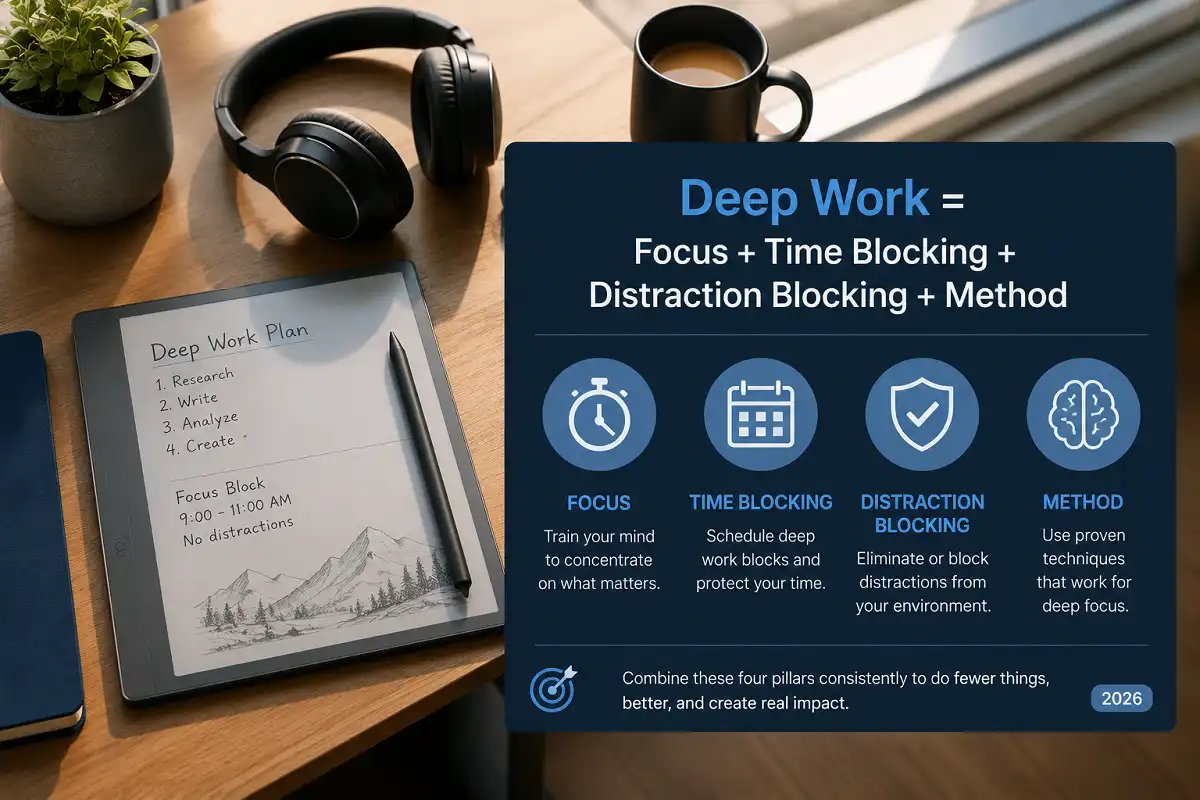
Most people struggle to focus for more than a few minutes. Notifications, tabs, and constant pings break concentration all day. The right deep work tools and techniques help you protect long, focused stretches and finish meaningful work faster. This guide shows you exactly what to use and how.
Deep work tools and techniques combine focus apps, time-blocking, distraction blockers, and dedicated hardware with proven methods like Pomodoro and single-tasking. Together they help you work without interruption, protect attention, and produce higher-quality results in less time.
What Is Deep Work?
Deep work is focused, undistracted effort on a cognitively demanding task. The term comes from author Cal Newport. It sits opposite to shallow work, which is easy, reactive, and low value.
During deep work, you give one task your full attention. No email. No social feeds. No task switching. This is when your best thinking happens.
The problem is simple. Modern tools are built to interrupt you. Winning back your focus takes intention and the right system.
Deep work also has a rhythm. You cannot force it on demand. Instead, you build conditions that make focus likely. The deep work tools and techniques in this guide create those conditions for you.
Why Deep Work Matters in 2026
Focused work produces better output in less time. Studies on attention show that task switching wastes minutes each time you change context. Those minutes add up fast.
Deep work also improves skill. When you concentrate fully, you learn faster and retain more. Shallow, distracted work does the opposite.
For students, writers, developers, and knowledge workers, focus is the real competitive edge. Speed matters, but depth matters more. This is why deep work tools and techniques have become essential rather than optional.
How Deep Work Tools and Techniques Work Together
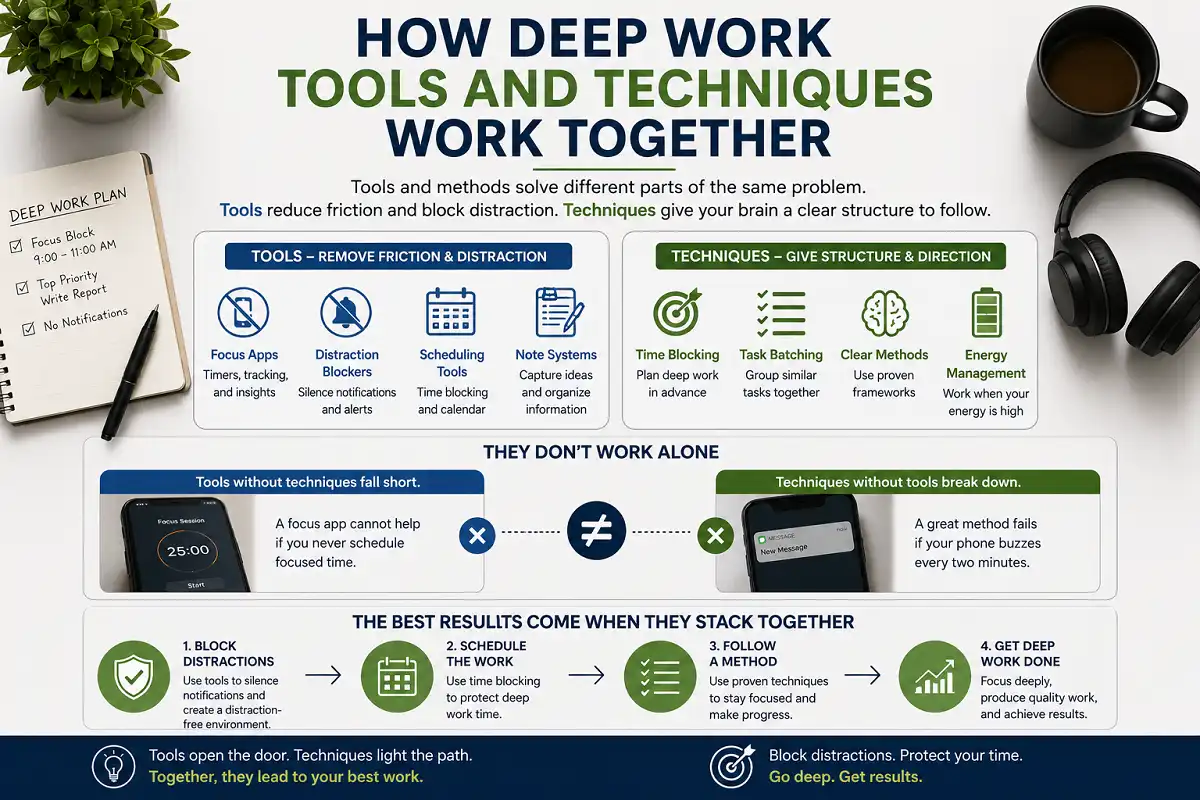
Tools and methods solve different parts of the same problem. Tools reduce friction and block distraction. Techniques give your brain a clear structure to follow.
Neither works alone. A focus app cannot help if you never schedule focused time. A great method fails if your phone buzzes every two minutes.
The best deep work tools and techniques stack together. You block distractions, schedule the work, and follow a method that keeps you on task.
15 Proven Deep Work Tools and Techniques
Below are fifteen practical options. Mix and match the ones that fit your work style.
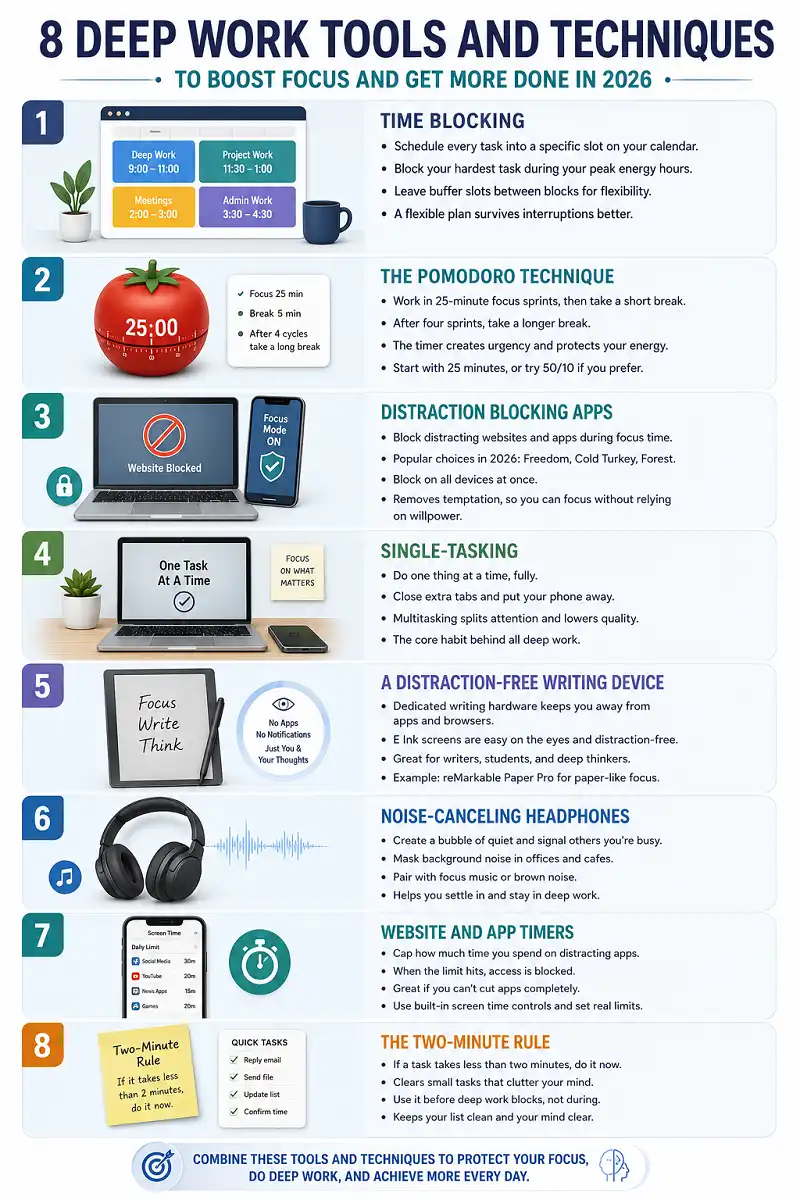
1. Time Blocking
Time blocking means scheduling every task into a specific slot on your calendar. You decide in advance when deep work happens.
This removes decision fatigue. You never wonder what to do next. You just follow the plan. Many people pair this with dedicated scheduling tools that structure the workday to protect focus blocks.
Block your hardest task during your peak energy hours. For most people, that is the morning.
Leave buffer slots between blocks. Real days rarely run on time, and rigid schedules snap under pressure. A flexible plan survives interruptions better than a strict one.
2. The Pomodoro Technique
Pomodoro breaks work into 25-minute focus sprints followed by short breaks. After four sprints, you take a longer break.
The timer creates urgency. It also protects your energy. Short breaks keep your mind fresh across a long session.
Start with 25 minutes. If that feels short, extend to 50-minute blocks with 10-minute breaks.
3. Distraction Blocking Apps
Blocker apps stop access to distracting sites and apps during focus time. Freedom, Cold Turkey, and Forest are popular choices in 2026.
Set a block schedule and let the app enforce it. Willpower alone rarely wins against a good app or feed.
Block on every device at once. Distraction moves to whichever screen is still open.
Blockers pair well with almost everything else here. Among all deep work tools and techniques, they give the fastest results because they remove temptation instead of relying on discipline.
4. Single-Tasking
Single-tasking means doing one thing at a time, fully. Multitasking feels productive but splits your attention and lowers quality.
Close every tab you do not need. Put your phone in another room. Give the task your whole mind.
This is the core habit behind all deep work tools and techniques. Everything else supports it.
5. A Distraction-Free Writing Device
Dedicated writing hardware removes the pull of apps and browsers. An E Ink tablet gives you a clean surface for thinking and drafting.
Because it does one job, there is nothing to click away to. Writers and students find this useful for long focus sessions. A good distraction-free device built for focused work can replace a cluttered laptop for drafting.
The reMarkable Paper Pro is one option if you want paper-like writing without notifications. The screen is easy on the eyes and holds no feeds to check.
If you draft, plan, or study by hand, a device like this can anchor your focus sessions. It gives your ideas a home that never pings you.
6. Noise-Canceling Headphones
Headphones create a bubble of quiet. They signal to others that you are busy. They also mask background noise in offices and cafes.
Pair them with focus music or brown noise if silence feels too sharp. Many people find steady sound helps them settle in.
7. Website and App Timers
Timers cap how long you spend on distracting apps each day. When the limit hits, access closes.
This works well for people who cannot cut apps completely. You still get access, just within firm limits.
Most phones now include built-in screen time controls. Turn them on and set real limits.
8. The Two-Minute Rule
If a task takes under two minutes, do it now. This clears small tasks that would otherwise clutter your mind during deep work.
The rule keeps your task list clean. A clear list means fewer nagging thoughts when you try to focus.
Use it before a deep work block, not during one. Do not let quick tasks interrupt your session.
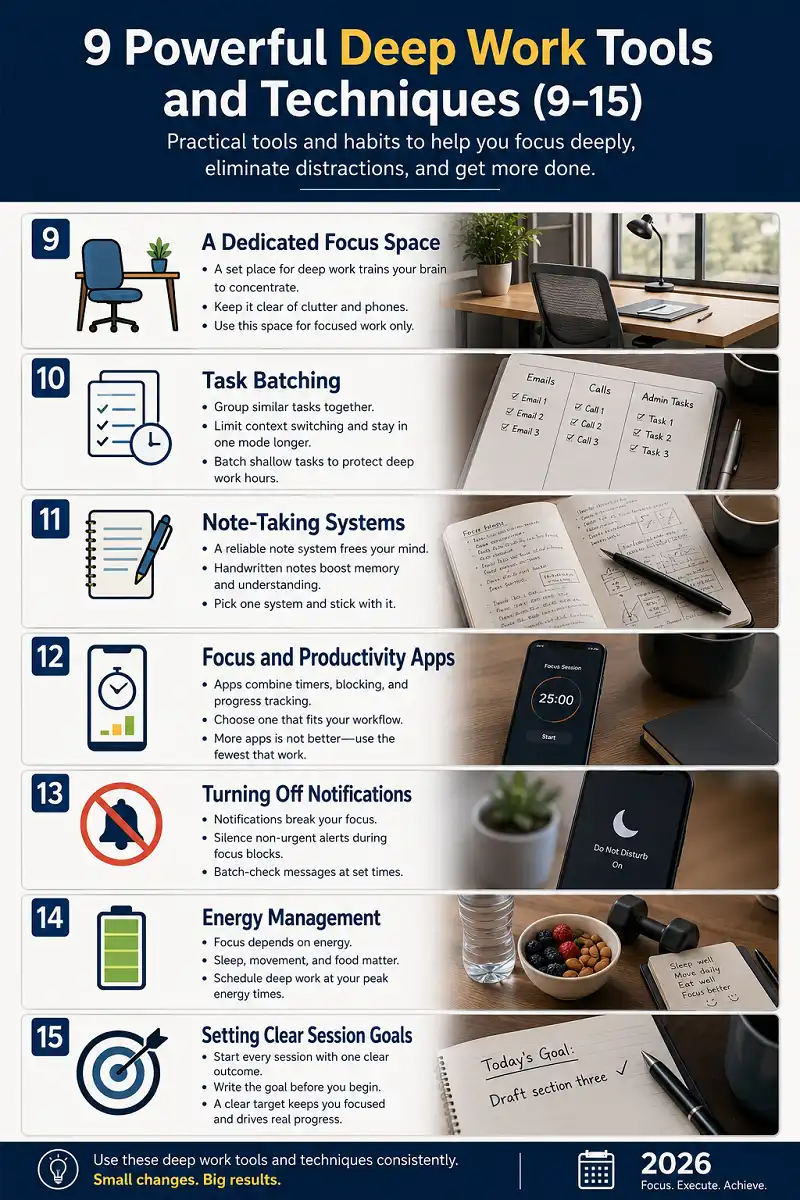
9. A Dedicated Focus Space
A set place for deep work trains your brain to concentrate. When you sit there, your mind knows it is time to work.
It does not need to be an office. A specific chair or desk works fine. Consistency is what matters.
Keep this space clear of clutter and phones. Reserve it for focused work only.
10. Task Batching
Batching groups similar tasks together. You answer all email at once, then make all calls at once.
This limits context switching. Your brain stays in one mode longer, which protects focus and speed.
Batch shallow tasks so they do not scatter across your day. Guard your deep work hours from them.
11. Note-Taking Systems
A reliable note system frees your mind. When you trust your notes, you stop trying to hold everything in your head.
Handwritten notes work especially well for memory. Strong note-taking methods that help you learn faster support deeper focus during study and research.
Pick one system and stick with it. Switching systems constantly becomes its own distraction.
12. Focus and Productivity Apps
Focus apps combine timers, blocking, and progress tracking in one place. Many also gamify your sessions to keep you motivated.
Choose one that fits your workflow instead of stacking five. A curated set of productivity apps that support remote and focused work can cover most needs.
More apps is not better. Pick the fewest tools that get the job done.
13. Turning Off Notifications
Notifications are the top enemy of deep work. Each buzz pulls your attention and breaks your flow.
Silence non-urgent alerts during focus blocks. Use do-not-disturb or focus modes on every device.
Batch-check messages at set times instead. Nothing truly urgent gets lost in a two-hour gap.
Silencing alerts costs nothing and protects the most. If you try only one of these deep work tools and techniques this week, make it this one.
14. Energy Management
Focus depends on energy, not just time. Sleep, movement, and food shape how well you concentrate.
Schedule deep work when your energy peaks. Protect your sleep and take real breaks to recharge.
No app can fix a tired brain. Manage energy first, then apply your tools.
15. Setting Clear Session Goals
Start every session with one clear outcome. Vague goals lead to wandering focus.
Write the goal before you begin. “Draft section three” beats “work on the report” every time.
A clear target keeps your deep work tools and techniques pointed at real progress.
Best Practices for Deep Work
Start small and build up. Begin with one 30-minute block per day, then grow it as your focus improves.
Protect your best hours. Give your hardest task the time when your mind is sharpest, not your leftover energy.
Review what works. Track your sessions and adjust. The right mix of deep work tools and techniques is personal, so keep refining it.
Common Mistakes to Avoid
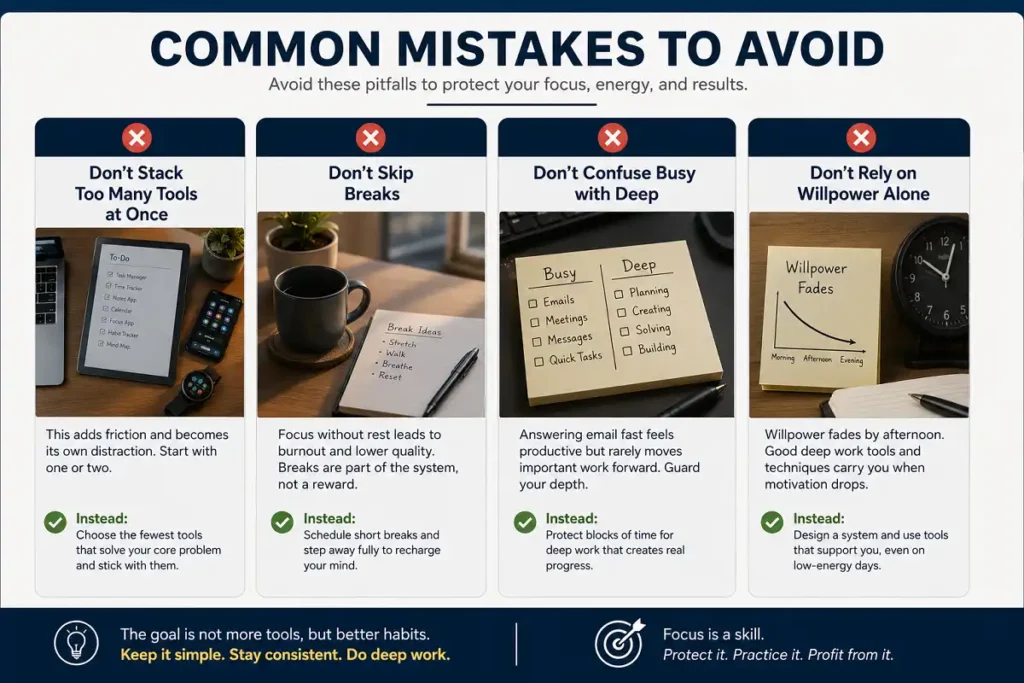
Do not stack too many tools at once. This adds friction and becomes its own distraction. Start with one or two.
Do not skip breaks. Focus without rest leads to burnout and lower quality. Breaks are part of the system, not a reward.
Do not confuse busy with deep. Answering email fast feels productive but rarely moves important work forward. Guard your depth.
Do not rely on willpower alone. Willpower fades by afternoon. Good deep work tools and techniques carry you when motivation drops.
Who Should Use These Tools and Techniques
Almost anyone who works or studies can benefit from deep work tools and techniques. The details differ by role, but the payoff is the same: better output with less wasted effort.
Students benefit from focus methods during study and revision. Deep work helps information stick and cuts study time.
Writers and creators need long, quiet stretches to produce their best work. These tools protect that space.
Developers and knowledge workers gain the most from blocking and batching. Their work demands sustained, uninterrupted thinking. Anyone doing focused work that reduces daily distraction will see results.
Building Your Own Deep Work System
You do not need every tool on this list. Pick two or three that fit your work and habits.
Combine one technique with one tool to start. Time blocking plus a distraction blocker is a strong first pairing.
Add more only when your current setup feels automatic. A small, consistent system beats a large, unused one. The most effective deep work tools and techniques are the ones you actually use each day.
How to Start Your First Deep Work Session Today
You can begin right now with no new purchases. Pick one important task and one 30-minute window.
Put your phone in another room. Close every tab except the one you need. Set a timer and start.
When the timer ends, stop and note what you finished. This single test shows you how much these deep work tools and techniques can change your output.
Repeat it tomorrow at the same time. Consistency turns a one-off session into a daily habit that compounds.
How to Measure Your Progress
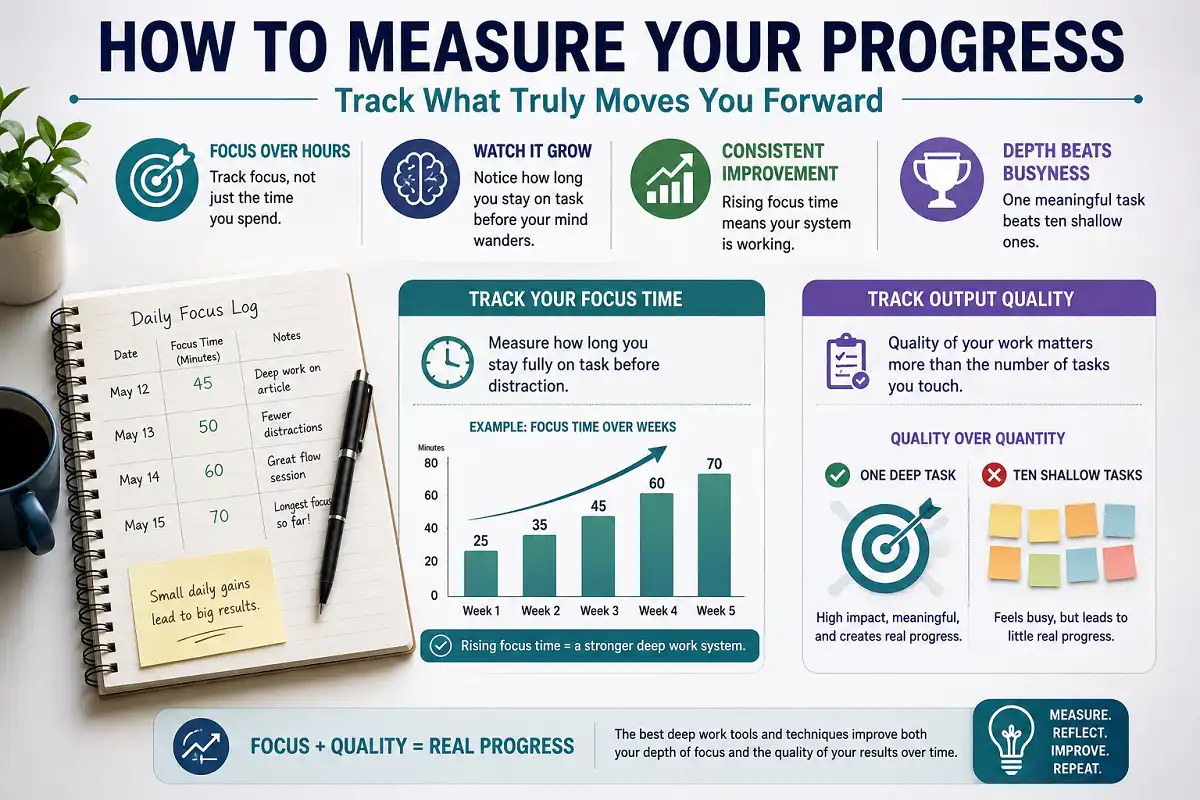
Track focus, not just hours. Note how long you stayed on task before your mind wandered.
Watch that number grow over weeks. Rising focus time means your system is working, even on hard days.
Also track output quality. Finishing one meaningful task beats touching ten shallow ones. The best deep work tools and techniques improve both depth and results over time.
FAQs

How long should a deep work session last?
Do I need special hardware for deep work?
Can deep work tools and techniques work for teams?
What is the single most useful habit?
Key Takeaways
Deep work is focused, undistracted effort on work that matters. It produces better results in less time.
The strongest approach combines tools and methods. Block distractions, schedule the work, and follow a clear structure.
Start with a small system and build from there. Consistency, not complexity, is what makes deep work tools and techniques pay off.
To learn more about the concept and its research background, see the overview of deep work on Wikipedia.