
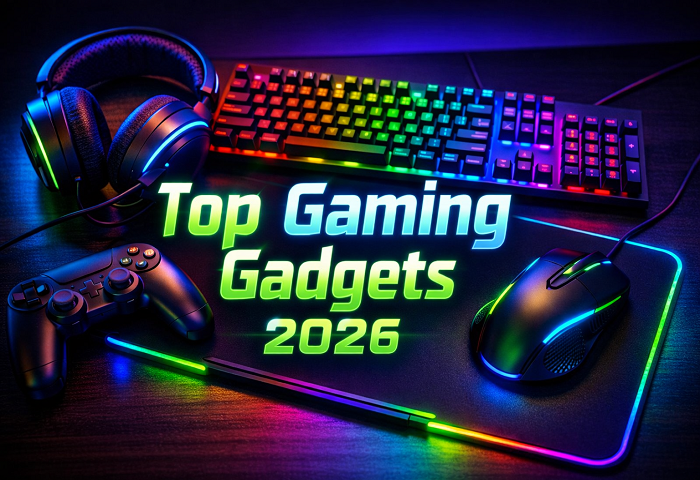
Introduction
If you have ever watched a professional streamer play and wondered why their gameplay looks smoother, their reactions feel faster, and their overall setup looks dialed in — the answer almost always comes down to gaming gadgets. Not raw talent alone, not just the game title, but the physical and digital tools surrounding that player every single time they sit down to compete or create.
Gaming gadgets are no longer a luxury category reserved for hardcore esports athletes or YouTube content creators pulling seven-figure incomes. In 2026, they have become an essential part of how millions of everyday gamers interact with their favorite titles. Whether you play first-person shooters, open-world RPGs, mobile battle royale games, or virtual reality experiences, there are gaming gadgets built specifically to enhance your performance and your comfort.
The problem most gamers run into is not a shortage of options — it is an overwhelming number of them. Marketplaces are flooded with products that promise everything and deliver very little. Knowing which gaming gadgets are worth your hard-earned money, and which ones are flashy packaging over poor engineering, requires real insight that most product roundups fail to provide.
This guide is different. We are going to walk through every major category of gaming gadgets in 2026, explain what each one actually does for your gameplay, break down what to look for when shopping, and highlight why certain features matter more than others. By the end of this article, you will have a clear picture of where to invest, what to skip, and how to build a setup that genuinely works for your play style and your budget.
Why Gaming Gadgets Matter More Than Ever in 2026
The gaming industry is larger than the global film and music industries combined. With more than three billion active gamers worldwide and the rise of competitive online play, the gap between a standard setup and a purpose-built gaming environment has never been wider — or more meaningful.
A decade ago, gaming gadgets were mostly cosmetic. RGB lighting, aggressive angular designs, and marketing buzzwords dominated the space. In 2026, the shift is dramatically different. The best gaming gadgets are now built around performance science, ergonomics research, and artificial intelligence integration. Gaming peripherals have evolved from simple input devices to smart accessories that adapt to your behavior, reduce physical strain, and actively improve reaction times.
Consider this: a gaming mouse with a polling rate of 8,000Hz reads your movement eight thousand times per second. That level of input accuracy has a direct and measurable impact on in-game aim, especially in fast-paced competitive titles where a few milliseconds separates a victory from a defeat. Or think about a gaming headset that uses AI-powered noise cancellation to isolate precise audio cues — footsteps, reload sounds, distant gunfire — giving you real positional awareness that standard speakers simply cannot match.
The point is this: modern gaming gadgets are not accessories. They are tools. And like any set of professional tools, the right ones make the job significantly easier.
Gaming Gadgets Category 1 — Monitors and Displays
Your monitor is the lens through which every game reaches you. No other single piece of gaming equipment has more daily impact on your visual experience than your display, making gaming monitors one of the most important gaming gadgets in any setup.
Refresh Rate and Response Time
In 2026, competitive gamers have largely settled on 144Hz as the minimum acceptable refresh rate, with many professionals moving to 240Hz or even 360Hz panels for fast-paced shooters. A higher refresh rate means more frames displayed per second, which directly translates to smoother motion and lower perceived input lag.
Response time is equally important. Look for monitors advertising 1ms GTG (gray-to-gray) response times. Slower panels create ghosting — a blurry trail behind fast-moving objects — which is both distracting and competitively disadvantageous.
Resolution Considerations
The 1080p vs 1440p vs 4K debate continues in 2026, but the gaming community has reached a practical consensus: 1440p at 165Hz or higher offers the best balance between visual clarity and frame rate performance for most players. Full 4K gaming is beautiful but still demands significant GPU horsepower, making it better suited for slower, story-driven games than competitive multiplayer.
Panel Technology
IPS panels remain the gold standard for color accuracy and wide viewing angles. OLED gaming monitors have arrived in force this year, offering perfect blacks, near-instant response times, and stunning contrast — though they carry a premium price tag. VA panels offer deep blacks at a lower cost but suffer from slower pixel transitions in fast motion.
Gaming Gadgets Category 2 — Gaming Mice
Among all gaming gadgets, the gaming mouse is arguably the most personal. It sits in your hand for hours at a time, translates every physical movement into in-game action, and its precision directly determines your ability to perform.
Sensor Technology
Modern gaming mice use optical sensors, and the best ones in 2026 are virtually flawless. Look for mice with sensors rated at 25,000 DPI or higher with zero acceleration, meaning the cursor moves predictably regardless of how fast you swipe. Top-tier sensor models include the PixArt PAW 3395 and PAW 3950, both of which are found in premium gaming gadgets from major brands.
Weight and Ergonomics
The honeycomb shell design that dominated gaming mice a few years ago has given way to more refined lightweight builds that sacrifice nothing structurally. Mice weighing between 50g and 70g are now common among elite gaming gadgets, reducing wrist fatigue during extended sessions.
Wireless Freedom
Wireless gaming mice in 2026 have completely closed the latency gap with wired alternatives. Technologies like 2.4GHz wireless with polling rates above 1,000Hz mean the difference between wired and wireless is functionally undetectable. Battery life has also improved dramatically, with many top gaming gadgets offering 70 to 100 hours on a single charge.
Gaming Gadgets Category 3 — Gaming Keyboards
A gaming keyboard might seem straightforward — you press keys, things happen — but the right keyboard among your gaming gadgets can have a surprising influence on both performance and comfort.
Mechanical vs. Membrane
Mechanical keyboards dominate the gaming gadgets space for good reason. Each key uses an individual mechanical switch that provides tactile feedback, consistent actuation force, and a lifespan typically exceeding 50 million keystrokes. The three main switch categories — linear, tactile, and clicky — each serve different play styles and personal preferences.
Linear switches like Cherry MX Red or Gateron Yellow are smooth with no bump, ideal for rapid key presses in gaming. Tactile switches provide a subtle bump at actuation point, which many typists and gamers prefer for accuracy. Clicky switches add an audible click alongside the tactile bump, though they can be noisy in shared spaces.
Form Factor Choices
Tenkeyless (TKL) keyboards that remove the numpad have become among the most popular gaming gadgets for desktop gamers because they allow the mouse to sit closer to the body, reducing shoulder strain. Compact 65% and 60% layouts take this even further, leaving only the keys most commonly used in gaming.
Wireless and Polling Rate
Like mice, wireless gaming keyboards have improved to the point where latency is negligible for gaming purposes. In 2026, several premium gaming keyboards offer 8,000Hz polling rates, matching the responsiveness of their wired counterparts.
Gaming Gadgets Category 4 — Gaming Headsets
Sound is the most underrated competitive advantage in gaming. A high-quality gaming headset delivers spatial audio information that standard speakers spread across a room simply cannot reproduce with the same precision. Among gaming gadgets, a great headset can fundamentally change how aware you are of your in-game environment.
Surround Sound and Spatial Audio
Virtual 7.1 surround sound has been a staple feature of gaming headsets for years, but 2026 has brought meaningful improvements through AI-driven head-related transfer function (HRTF) processing. This technology models how sound reaches your ears from different directions, creating a convincing three-dimensional audio space that helps you pinpoint the origin of sounds like footsteps, explosions, and enemy movement.
Microphone Quality
Online multiplayer gaming means communication, and a poor microphone is a real liability for team play. The best gaming gadgets in the headset category now include AI noise-canceling microphones that distinguish your voice from background noise — fan sounds, keyboard clicks, household activity — in real time. This results in cleaner voice communication for your teammates and a more professional sound for streamers.
Open-Back vs. Closed-Back
Open-back headsets allow air and sound to pass through the earcups, creating a more natural, spacious soundstage that many gamers prefer for immersive single-player experiences. Closed-back designs isolate external noise better, making them the preferred choice among competitive gaming gadgets for tournament and LAN environments.
Gaming Gadgets Category 5 — Gaming Controllers
Controllers are no longer exclusively the domain of console players. In 2026, a significant portion of PC gamers reach for a controller for specific genres — action-adventure games, fighting games, racing simulators, and platformers all feel more natural with an analog input device.
Hall Effect Joysticks
One of the biggest talking points in gaming gadgets this year is hall effect technology in controller thumbsticks. Traditional potentiometer-based joysticks wear out and develop stick drift over time. Hall effect sticks use magnets instead of physical contact to read position, meaning they are theoretically immune to drift and offer far longer operational lifespans.
Adaptive Triggers and Haptic Feedback
Sony introduced adaptive triggers with the PlayStation 5’s DualSense, and in 2026, the technology has matured significantly. Resistance can be programmed by developers to simulate bowstring tension, weapon recoil, terrain friction under a vehicle, or water resistance, adding a physical dimension to gameplay that is genuinely immersive among the newest gaming gadgets.
Third-Party Pro Controllers
The market for pro-tier third-party controllers has expanded substantially. Brands now offer controllers with customizable rear paddles, adjustable trigger stops, swappable components, and premium build quality that rivals or exceeds first-party options. These gaming gadgets appeal especially to competitive players who want to configure controls to their exact specification.
Gaming Gadgets Category 6 — Gaming Chairs and Desks
Ergonomics might be the least glamorous category of gaming gadgets, but it is also the one with the most direct impact on your health and your ability to play for extended periods without pain or injury.
What to Look for in a Gaming Chair
The flashy racing-seat aesthetic that dominated the gaming chairs market for years is giving way to ergonomic office-style designs. The best gaming gadgets in this category in 2026 prioritize lumbar support, adjustable armrests, seat depth adjustment, and high-quality foam density over color schemes and wing-back designs.
Look for chairs with a 4D armrest system (adjustable in four directions), adjustable lumbar support rather than a fixed pillow, a seat that tilts and rocks, and a weight capacity appropriate for your body type. Neck support pillows should be optional rather than forced on you by a tall, fixed headrest.
Gaming Desks
A proper gaming desk is often overlooked among gaming gadgets but makes a meaningful difference. Cable management systems, monitor arm compatibility, surface coatings that work well with mouse pads, and sitting height are all considerations. Sit-stand desks are increasingly popular in gaming setups, and 2026 models offer programmable height memory and quieter lifting motors.
Gaming Gadgets Category 7 — VR and Immersive Technology
Virtual reality gaming represents one of the most exciting frontiers in gaming gadgets. The technology has matured significantly since its first consumer wave, and 2026 headsets offer a compelling experience that no other gaming gadget can replicate.
Standalone vs. PC-Tethered Headsets
Standalone VR headsets run on self-contained hardware, requiring no PC or console connection. They offer freedom of movement and simplified setup. PC-tethered headsets, whether through a cable or wireless streaming, deliver higher graphical fidelity by offloading processing to a dedicated gaming PC.
Key Specs in VR Gaming Gadgets
Resolution per eye, refresh rate, field of view, and tracking accuracy are the four pillars of VR headset quality. In 2026, the leading gaming gadgets in this category achieve resolutions exceeding 2,500 x 2,500 per eye, refresh rates of 120Hz or higher, and inside-out tracking that requires no external base stations.
Who VR Gaming Gadgets Are Actually For
VR gaming gadgets deliver their best experience to players willing to invest time in setup, have physical space to move in, and enjoy immersive, slower-paced experiences rather than competitive twitch shooting. For the right player, nothing in the gaming gadgets space is more exciting.
Gaming Gadgets Category 8 — Capture Cards and Streaming Accessories
Gaming has grown beyond playing. Millions of gamers now create content alongside their gameplay, and this has driven explosive growth in the streaming accessories segment of gaming gadgets.
Capture Cards
A capture card sits between your console or PC and your recording software, capturing the video signal so it can be broadcast or recorded in high quality. In 2026, 4K60 capture with low latency passthrough has become the standard for serious content creators. These gaming gadgets are essential for anyone streaming from a console to a PC-based broadcasting setup.
Stream Decks and Control Surfaces
The Stream Deck — a small panel of programmable LCD buttons — has become one of the most beloved gaming gadgets among streamers. With a single button press, streamers can switch scenes, trigger sound effects, send chat messages, control lighting, and execute macros. The product category has expanded significantly, with competitors offering similar devices at various price points.
Microphones and Lighting
Standalone USB condenser microphones and ring lights or key lights complete the streaming gaming gadgets setup. In 2026, AI-powered background removal has reduced the need for physical green screens, and smart key lights that integrate with streaming software allow automated scene changes.
Building Your Gaming Gadgets Setup: A Practical Priority Guide
With so many categories of gaming gadgets to consider, the question becomes one of priority. You cannot buy everything at once — and you should not try to. Here is a sensible order of investment for building a setup that delivers real performance gains:
First Priority — Input Devices: Your gaming mouse and keyboard have the most direct impact on competitive performance. Start here. A precise, comfortable gaming mouse and a mechanical keyboard with the right switches will immediately improve your gameplay experience.
Second Priority — Display: A high refresh rate monitor transforms how smooth games feel. Moving from 60Hz to 144Hz is one of the most dramatic perceptual improvements available among gaming gadgets.
Third Priority — Audio: A quality gaming headset provides both competitive audio advantage and communication clarity. This matters enormously in team-based multiplayer games.
Fourth Priority — Comfort and Ergonomics: A good chair and desk setup protects your body during long sessions. This is a long-term investment in your health that pays dividends for years.
Fifth Priority — Specialty Gadgets: VR headsets, streaming equipment, and controllers fall into the category of gaming gadgets that enhance specific aspects of your hobby once the fundamentals are covered.
What to Avoid When Buying Gaming Gadgets
As important as knowing what to buy is knowing what to avoid. The gaming gadgets market has its share of underperformers dressed up in attractive packaging:
RGB as a selling point: Lighting is cosmetic. RGB integration is fun and can unify an aesthetic, but never pay a premium for it in gaming gadgets if the core specs are weaker than alternatives at the same price.
Inflated DPI claims on budget mice: Many budget gaming gadgets advertise enormous DPI figures that are mathematically interpolated rather than natively tracked, producing jittery, inaccurate cursor movement at high sensitivity. Stick to proven sensors.
Proprietary ecosystem lock-in: Some brands design gaming gadgets that only work optimally with their own software ecosystem, accessories, or other products. Prioritize open standards where possible.
Chairs with poor lumbar support: An uncomfortable chair is worse for your health than no gaming chair at all. Avoid designs that force posture rather than support natural sitting positions.
The Future of Gaming Gadgets
Looking ahead, the trajectory of gaming gadgets points clearly toward greater intelligence, greater personalization, and greater integration. AI is already reshaping audio processing, sensor calibration, and display technology across gaming peripherals. Biometric integration — heart rate monitoring, eye tracking, and even EEG-based attention sensors — is beginning to appear in experimental gaming gadgets designed to adapt game environments and accessibility features in real time.
Cloud gaming infrastructure is also changing the hardware requirements for players. As services deliver high-fidelity game streaming to thin clients and mobile devices, the emphasis shifts away from powerful local hardware toward quality input gaming gadgets — low-latency controllers, responsive displays, and excellent audio equipment that does not depend on a powerful PC underneath them.
The gaming gadgets space will continue to be one of the most innovative consumer technology markets in the world. For gamers who want to stay ahead, staying informed about what is actually useful versus what is merely marketed aggressively will remain the key skill.
Conclusion
Gaming gadgets in 2026 are smarter, more capable, and more accessible than at any point in the history of the hobby. Whether you are a casual player who wants more comfort, a competitive gamer chasing performance improvements, or a content creator building a professional streaming environment, there are gaming gadgets designed specifically for your goals.
The key is to invest deliberately. Understand what each category of gaming gadgets actually offers, prioritize based on your play style, and ignore the noise of trend-driven marketing. A well-built setup does not need to cost a fortune — it needs to match your needs.
Start with the fundamentals: a responsive mouse, a reliable keyboard, a clear monitor, and a comfortable place to sit. Build from there. Your gaming experience will improve in ways that go far beyond what any single gadget alone can achieve.