
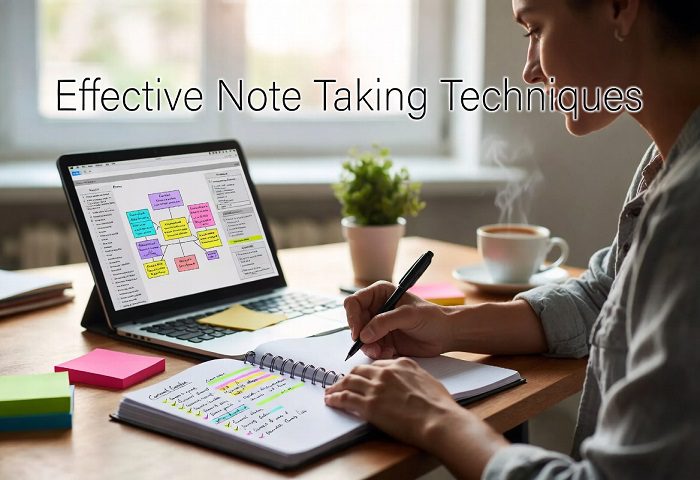
1. What Is Note Taking and Why Does It Matter?
Note taking is the deliberate practice of writing down, typing, or visually organizing information for later reference and review. Whether you are sitting in a college lecture hall, attending a business meeting, reading a complex textbook, or watching a tutorial video online, the act of capturing information actively transforms passive listening into an engaged learning process.
At its simplest level, note taking serves as an external memory — a personal archive that you can return to days, weeks, or even months after the original event. But effective note taking goes far beyond just saving facts. When done correctly, the process of writing notes forces your brain to process, evaluate, and restructure information in real time. This active engagement is precisely what separates students who remember what they learn from those who forget material the moment the class ends.
In academic settings, strong note-taking habits consistently correlate with higher grades, greater comprehension, and deeper conceptual understanding. In professional environments, organized notes from meetings and research sessions save time, reduce miscommunication, and sharpen decision-making. Even in personal life, people who practice consistent note taking tend to be more creative, better organized, and more effective at turning ideas into action.
The skill of note taking is far more nuanced than most people assume. It is not simply about writing down everything you hear. It is a dynamic intellectual activity — one that requires you to listen critically, filter for importance, identify key concepts, and organize information in a way that will make sense to your future self.
34%
50%
80%
1950s
2. The Science Behind Effective Note-Taking
To truly understand the power of note taking, it helps to look at what neuroscience and educational psychology have to say. Research consistently demonstrates that the act of writing information by hand activates different neural pathways compared to simply listening or reading. When you take notes, you are essentially encoding information twice — once when you hear it and again when you write it down — reinforcing memory formation.
A landmark study published in Psychological Science compared students who took notes by hand versus those who typed on laptops. The results were striking. While laptop note-takers captured more raw words, students who wrote by hand showed significantly better understanding of concepts and performed better on assessments. The reason? Handwriting forces a degree of active processing. You physically cannot write as fast as someone can talk, so your brain must summarize, paraphrase, and prioritize — all of which are powerful learning activities in their own right.
“Note taking is the process of writing down, typing, or crafting graphical representation of information for later reference. It promotes encoding of information — not merely storing it.”— Center for the Advancement of Teaching Excellence, University of Illinois Chicago
More recent research published in Frontiers in Psychology (2025) found that structured note taking methods like the Cornell method and parallel two-column notes significantly increased both motivation and long-term retention compared to digital or sentence-based methods. The researchers concluded that formats such as Cornell and Parallel notes provide teachable steps — identifying cues, organizing content, and summarizing — that help students develop more effective strategies.
The science of memory also plays a big role here. Herman Ebbinghaus’s famous Forgetting Curve illustrates that without review, humans forget roughly 50% of new information within an hour. After a week, up to 90% of that information can vanish. Consistent note-taking, combined with timely review, directly combats this natural forgetting process. Notes serve as checkpoints that allow you to revisit information at the ideal moment for memory consolidation.

Top Note-Taking Methods Explained
There is no single best note-taking method that works for every person in every situation. The right approach depends on the type of content you are encountering, your learning style, and your goals. Below are the most effective and widely used note taking systems, each with distinct strengths.
📐 The Cornell Method
Divide your page into three sections: a wide main column for notes, a narrow left column for cues and keywords, and a bottom summary box. After the lecture, write questions and keywords in the cue column, then summarize the page in your own words. Ideal for lectures, reading, and exam preparation.
📝 The Outline Method
Organize information into a hierarchical structure using main topics and indented subtopics. This is one of the most clean, structured note taking techniques and works especially well for content that has clear categories and relationships – like textbook chapters or structured presentations.
🗺️ Mind Mapping
Start with a central concept in the middle of the page and branch outward with related ideas, subtopics, and keywords. Mind mapping is a highly visual note taking method that excels for brainstorming sessions, creative projects, and subjects that involve complex relationships between ideas.
📊 The Charting Method
Create a table with categories as column headers and fill in facts below each one. This note taking method is perfect for comparative information — historical events, scientific data, product comparisons, or any content with a lot of facts organized across common attributes.
💬 The Sentence Method
Write each new piece of information as a complete new sentence on a separate line. While fast and simple, this method requires you to review and reorganize later. Best for fast-paced lectures where you need to capture everything quickly before refining your notes afterward.
⚡ The Flow-Based Method
Instead of formal structure, capture information in a flowing, connected way using arrows, diagrams, sketches, and short phrases. This approach prioritizes understanding over completeness, making it great for creative learners who thrive on seeing connections and drawing insight in real time.
Choosing the right note-taking method is a personal journey. Effective note taking begins when a student understands the purpose of a class and how they will best engage with the material — it might take some trial and error to find what works best for you, and that is completely okay. Many learners benefit from combining techniques — for example, using the outline method during a lecture, then reorganizing into a Cornell format during review.
Digital vs. Handwritten Note-Taking
One of the most debated topics in modern education and productivity is whether it is better to take notes by hand or type them on a device. Both approaches have genuine merits, and the right choice ultimately depends on your purpose, environment, and personal workflow.
Handwritten Notes
The strongest case for handwritten note taking lies in its cognitive benefits. Taking notes by hand requires a deeper engagement with the material, helping you retain more information because you must actively summarize rather than transcribe word for word. Handwriting activates motor memory, which adds an extra layer of encoding. Studies show this leads to better comprehension of concepts, even if handwritten notes contain less raw information than typed ones.
Handwritten notes are also free from digital distractions — no notifications, no browser tabs, no temptation to check social media. For students who struggle with focus, a simple notebook and pen may be the most effective productivity tool available. Additionally, drawing diagrams, arrows, and sketches is natural on paper, making handwritten notes ideal for subjects involving visual relationships like biology, chemistry, and mathematics.
Digital Note-Taking
Digital note-taking offers enormous practical advantages. Speed is the most obvious one — most people type significantly faster than they write, making it easier to keep pace with fast-moving lectures or meetings. Digital notes are also instantly searchable, easily organized, backed up to the cloud, and accessible from any device anywhere in the world.
Modern digital note taking apps support multimedia integration — you can embed images, record audio, attach PDFs, add hyperlinks, and even draw on a tablet with a stylus, blending the tactile benefits of handwriting with the flexibility of digital organization. For long-form research, collaborative projects, or knowledge management, digital tools are almost always the superior choice.
Pro Tip: The hybrid approach is increasingly popular — use a tablet with a stylus (like an iPad with Apple Pencil or a reMarkable tablet) to write by hand while getting all the organizational and cloud-sync benefits of digital note-taking. You get the cognitive benefits of handwriting without sacrificing the convenience of digital storage.
Best Note-Taking Apps in 2025
The market for digital note taking tools has never been richer. Whether you are a student managing course notes, a researcher building a knowledge base, or a professional capturing meeting action items, there is a dedicated note-taking app designed for your needs.
Notion remains one of the most versatile note taking and knowledge management platforms, offering databases, linked pages, templates, and collaborative workspaces. It is ideal for people who want to build interconnected knowledge systems and organize everything in one place.
Obsidian is the tool of choice for researchers, writers, and knowledge workers who embrace the “second brain” philosophy. Built around linked markdown files, it allows you to create a personal knowledge graph where every idea connects to related notes — a powerful way to surface insights over time.
Evernote remains a trusted classic for general note taking, with strong OCR capabilities, cross-platform sync, and robust web clipper functionality. It is particularly useful for people who want to save articles, images, and research materials alongside their own notes.
Goodnotes and Notability are the gold standard for handwritten digital note taking on iPad. Both apps allow you to write with a stylus, annotate PDFs, organize notebooks, and search through your handwriting — making them beloved among students and professionals who prefer the feel of pen on paper.
Microsoft OneNote is a powerful, free option deeply integrated into the Microsoft 365 ecosystem, making it a natural choice for corporate environments and anyone already using Word, Excel, and Teams in their workflow.
6. Ten Proven Note Taking Tips for Students and Professionals
Knowing the methods is one thing. Building the habits that make note-taking consistently effective is another. Here are ten actionable strategies to sharpen your note taking skills immediately.
- Prepare before you begin. Review any available materials — a syllabus, agenda, or chapter preview — before the lecture or meeting starts. Arriving with context makes it far easier to identify what is important and what can be skipped.
- Write in your own words. Resist the urge to transcribe verbatim. Summarizing in your own language forces active comprehension and dramatically improves memory retention compared to passive copying.
- Use abbreviations and symbols. Develop a personal shorthand system so you can capture ideas faster. Common examples include arrows for relationships, asterisks for important points, and “w/” for “with.”
- Focus on key concepts, not every word. Capture main ideas, supporting examples, and critical facts. Trying to write down everything leads to cognitive overload and causes you to miss the big picture.
- Leave white space for additions. Do not fill every line. Leaving gaps allows you to add context, examples, or clarifications when you review your notes later — a practice that reinforces memory consolidation.
- Review notes within 24 hours. The Ebbinghaus Forgetting Curve shows that memory fades rapidly. Reviewing your note taking output within a day reinforces learning at the most effective point in the memory cycle.
- Ask questions as you go. Write down questions that arise while taking notes. These become powerful study prompts during review and help identify gaps in understanding that need follow-up.
- Use color coding and visual highlights. Assign consistent colors to different types of information — red for definitions, blue for examples, green for key concepts. Visual organization makes review faster and more effective.
- Organize notes immediately after the session. Spend five to ten minutes post-lecture or post-meeting organizing your note-taking document. Add a brief summary, clarify unclear points, and tag or file the notes in your knowledge system.
- Experiment and iterate. No single note-taking strategy is perfect for every situation. Test different methods — Cornell, outline, mind mapping — and pay attention to which approach helps you retain and apply information most effectively.
7. Frequently Asked Questions About Note-Taking
8. Conclusion: Your Notes Are Your Superpower
Note-taking is far more than a classroom habit or a business formality. It is a foundational cognitive skill that shapes how deeply you understand information, how long you retain knowledge, and how effectively you convert ideas into action. When practiced intentionally and consistently, note taking becomes one of the highest-return skills you can develop — for academic success, professional performance, and lifelong learning.
The most important thing is not which method you choose, but that you choose deliberately. Understand your own learning style. Consider the type of content you are capturing. Experiment with the Cornell method, outlining, mind mapping, or charting until you find what clicks. Embrace digital tools where they help, preserve the tactile benefits of handwriting where they serve you better.
Review your notes consistently, write in your own words, leave space for reflection, and treat your notes as a living document — something that grows and connects over time rather than a static record of a single moment. Do that, and your note taking practice will become one of the most valuable intellectual assets in your life.