
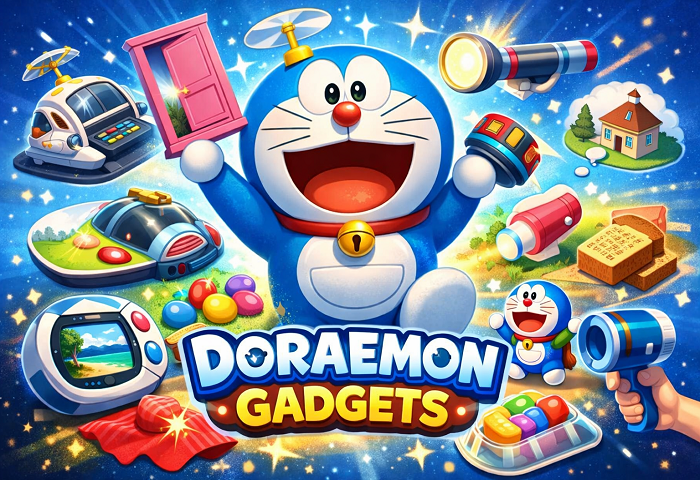
Introduction: Why Doraemon Gadgets Still Capture Our Imagination
There is something wonderfully timeless about a blue robotic cat who pulls extraordinary inventions out of a pocket in his belly. For decades, children, teenagers, and adults across Asia and beyond have sat glued to their television screens, watching Nobita Nobi — the lovable, lazy schoolboy — get out of trouble (and sometimes into more trouble) thanks to the remarkable Doraemon gadgets that appear from that magical 4D pocket. Whether you grew up watching the original Japanese anime, the Hindi-dubbed version, or reading the manga, the gadgets in this series have left a permanent mark on popular culture.
The universe of Doraemon gadgets is not just entertainment. These futuristic tools have inspired engineers, designers, scientists, and dreamers who grew up watching the show and later went on to create real-world technologies. Doraemon gadgets represent the intersection of childlike wonder and serious scientific imagination. This article takes a deep, comprehensive look at the most iconic Doraemon gadgets, their functions, their cultural significance, and the surprising ways some of them resemble technology we actually use today.
The 4D Pocket: Where All Doraemon Gadgets Come From
Before diving into individual Doraemon gadgets, it is worth understanding the source of them all — the famous 4D pocket embedded in Doraemon’s belly. This pocket exists in a fourth-dimensional space, meaning it holds an effectively unlimited number of items despite appearing small from the outside. It functions as a wearable storage device of incomprehensible capacity, connecting to a warehouse located in the future.
The 4D pocket is perhaps the most important of all Doraemon gadgets because it symbolizes one central idea: the future holds solutions to today’s problems. Every gadget Doraemon pulls out carries this message. The pocket itself can be considered the original smart bag — an idea that today’s tech world echoes in cloud storage, where unlimited digital space is accessible from a small device in your hand.
Take-Copter (Bamboo Copter): The Flying Dream
Of all the Doraemon gadgets ever shown in the anime, the Take-Copter — often called the bamboo-copter or propeller cap — is probably the most universally recognized. It is a small helicopter-like rotor that attaches to the top of the head or to clothing, allowing the wearer to fly freely through the air at will.
The Take-Copter is beloved because it represents humanity’s oldest dream: the ability to fly without machines, wings, or engines. Children watching Doraemon immediately understood the appeal. No need for airports, no turbulence, no seat belts — just a tiny rotor on your head and the open sky. The gadget appears in hundreds of episodes and is the go-to transportation device in the series.
From a modern technology perspective, the Take-Copter bears a striking resemblance to personal drone technology and jetpacks, both of which are rapidly advancing in 2024 and beyond. Companies are actively developing personal aerial vehicles and small body-mounted flight devices. While we haven’t cracked a forehead-mounted rotor quite yet, the spirit of the Take-Copter is very much alive in today’s aerospace innovation.
Anywhere Door (Dokodemo Door): Teleportation Made Simple
Among all Doraemon gadgets, the Anywhere Door — called Dokodemo Door in Japanese — stands as perhaps the most philosophically powerful. It is a pink door that, when opened while thinking of a destination, transports the user instantly to that exact location anywhere in the world (or the universe, in some episodes). No travel time, no jet lag, no logistics.
The Anywhere Door encapsulates one of the most persistent human desires: to remove the friction of distance. Whether Nobita wants to visit a friend, escape trouble, or travel to a faraway place, the Anywhere Door makes space irrelevant. It has appeared in almost every story arc of the Doraemon franchise and is arguably the signature gadget of the entire series.
In the modern world, the closest parallel to this gadget is the internet. While we cannot physically teleport, we can connect with anyone anywhere in seconds, attend virtual meetings, and experience far-off places through video. Some futurists argue that the internet is the first-generation Anywhere Door — we’ve achieved mental and communicative teleportation even if physical teleportation remains science fiction.
Small Light and Big Light: Resizing the World
Another pair of iconic Doraemon gadgets that have fascinated fans for generations are the Small Light and the Big Light. The Small Light shrinks any object or person to a fraction of its original size, while the Big Light reverses the effect, restoring or enlarging things. Together, these tools represent one of the most versatile gadget duos in the series.
The Small Light has been used to shrink Nobita out of trouble, reduce large problems to manageable sizes (literally), and enable adventures in miniature worlds. The Big Light, on the other hand, has been used to enlarge toys, food, and even Doraemon himself during various plot emergencies.
The scientific concept underlying the Small Light relates to nanotechnology and miniaturization — real fields that have transformed medicine, electronics, and manufacturing. Modern microchips, nanobots used in medical research, and the miniaturization of computers from room-sized machines to pocket devices all echo the spirit of the Small Light. These are not just fanciful Doraemon gadgets; they are concepts that real scientists take seriously.
Memory Bread: Learning Made Delicious
Among the Doraemon gadgets that students would most desperately want in real life, Memory Bread takes a very special place. This gadget allows Nobita to press a page of his textbook against a slice of bread. The text is then transferred to the bread, and when eaten, the information is automatically memorized by the person who consumes it.
Memory Bread consistently ranks among the most popular Doraemon gadgets in fan polls, for obvious reasons. The concept of effortless learning — absorbing entire textbooks overnight simply by eating — speaks to every student who has ever struggled with exams. It blends the comfort of food with the anxiety of academic performance in a single, genius invention.
In the real world, neuroscience and cognitive science are studying ways to enhance memory and learning efficiency. While we cannot yet eat information, researchers are exploring techniques such as targeted memory reactivation, nootropic supplements, and brain stimulation methods that aim to improve how quickly and effectively humans absorb and retain knowledge. The dream behind Memory Bread — making learning faster and less painful — drives billions of dollars in edtech and neuroscience research today.
Translate Konjac: Breaking Language Barriers
Communication across language barriers has always been a challenge, and Doraemon addressed this with one of the most culturally significant Doraemon gadgets: the Translate Konjac. This edible jelly allows whoever eats it to understand and speak any language fluently. One piece of the konjac is all that is needed for complete linguistic comprehension.
This gadget speaks directly to one of the fundamental divides in human society — language. The idea that a single, simple food item could grant access to every language on Earth is both charming and deeply hopeful. It implies a world without communication barriers, where misunderstandings rooted in language simply cease to exist.
Today’s AI translation technology is perhaps the closest real-world equivalent to the Translate Konjac. Tools like real-time translation earbuds, instant text translation on mobile phones, and AI-powered interpretation software bring us remarkably close to the gadget’s vision. While imperfect, these technologies represent genuine progress toward the barrier-free communication world that Translate Konjac imagined decades ago.
The Hopter and Time Machine: Playing With Time
The concept of time is central to the entire Doraemon narrative, since Doraemon himself is a robot from the 22nd century sent back to the present. It is no surprise then that some of the most compelling Doraemon gadgets relate to time manipulation. The Time Machine is the vehicle that Doraemon used to travel to Nobita’s era, stored beneath a desk drawer that acts as a dimensional gateway.
The Time Machine allows travel to any point in the past or future. While primarily a narrative device rather than a frequently used “gadget of the week,” it is philosophically the most important invention in the entire Doraemon universe. It raises questions about determinism, free will, and the responsibility that comes with foreknowledge of the future.
Physics tells us that time travel to the future is theoretically possible — traveling close to the speed of light slows down time relative to a stationary observer, a phenomenon confirmed by experiments with atomic clocks. Traveling to the past, however, remains firmly in the realm of theoretical speculation. But the conversations that Doraemon gadgets like the Time Machine inspire are exactly the kind of boundary-pushing thinking that drives theoretical physics research.
Gian’s Recorder and the Sound Crayon: Lesser-Known Gems
Not all beloved Doraemon gadgets are world-changing technologies. Some are charmingly simple. The Sound Crayon, for example, allows the user to draw pictures that come to life with realistic sound. Drawing a dog produces actual barking sounds; drawing a tree in a breeze creates the sound of rustling leaves.
This gadget is an early vision of what we might now call augmented reality or immersive media. In modern technology, augmented reality headsets, spatial audio systems, and AI-generated sound design all push in exactly the direction the Sound Crayon imagined — creating richer, more multisensory media experiences.
Another fan favorite among quirky Doraemon gadgets is the What-If Phone Box, a booth that transports the user to an alternate reality where a “what if” scenario is actually true. Want to know what life would be like if you had studied harder? Step into the booth. This gadget directly parallels modern interest in multiverse theory and the growing genre of alternate-history fiction, both in literature and film.
Real-World Technologies Inspired by Doraemon Gadgets
It would be impossible to write about Doraemon gadgets without acknowledging their genuine influence on real-world innovation. Japanese engineers and technology professionals have openly cited Doraemon as an inspiration throughout their careers. Sony, Toyota, and various robotics firms have referenced Doraemon gadgets when articulating aspirational technology goals.
The Japanese government itself has used Doraemon as a cultural symbol, and there are documented cases of engineers designing medical robots, drone delivery systems, and translation tools while explicitly referencing specific Doraemon gadgets as their conceptual starting points. This is not coincidence. Doraemon gadgets were so well-imagined, so grounded in human need, and so thoughtfully designed within their fictional universe that they naturally map onto real engineering challenges.
Consider these parallels:
The Take-Copter matches personal drone development and jetpack technology. The Anywhere Door mirrors the internet and teleconferencing. The Small Light echoes nanotechnology and miniaturization in semiconductors. Memory Bread parallels nootropics, memory enhancement research, and AI-assisted learning tools. The Translate Konjac reflects real-time AI translation devices. The 4D Pocket is conceptually identical to cloud storage and distributed computing.
These are not superficial comparisons. The underlying human needs — mobility, communication, knowledge, connection, storage — that the Doraemon gadgets were designed to address are the same needs driving the world’s most significant technological advances today.
The Cultural Legacy of Doraemon Gadgets
Beyond technology, Doraemon gadgets carry deep cultural meaning, particularly across Asia. In Japan, India, China, Southeast Asia, and many other regions, the gadgets have become shared cultural references that transcend generations. Parents who grew up watching Doraemon now watch it with their children, and the gadgets serve as a common language of imagination and hope.
The popularity of Doraemon gadgets in merchandise, toys, games, and educational content speaks to their enduring resonance. Toy versions of the Take-Copter, the Anywhere Door, and the 4D pocket are perennial bestsellers. Educational apps and books reference Doraemon gadgets to teach science, technology, and problem-solving concepts to young children. Museums dedicated to Doraemon have featured interactive exhibits exploring the science behind the gadgets.
This cultural legacy matters because it shows how storytelling and science fiction can shape public attitudes toward technology and innovation. Children who grew up dreaming about Doraemon gadgets grew up with a fundamentally optimistic view of what technology can do for human life. They didn’t just inherit technology — they were primed to imagine it, demand it, and eventually build it.
Doraemon Gadgets and the Ethics of Technology
Any comprehensive discussion of Doraemon gadgets must also address their darker side, which the anime itself frequently explored. Doraemon is notable among children’s anime for consistently presenting a nuanced moral universe. Gadgets that are misused lead to bad outcomes — almost without exception.
When Nobita uses the Anywhere Door to spy on others, consequences follow. When he uses Memory Bread as a shortcut instead of actually studying, the deeper problem remains unsolved. When the What-If Phone Box reveals an alternate reality, it often shows that the grass isn’t necessarily greener on the other side. The Doraemon gadgets, in this sense, function as moral teaching tools as much as fantastical entertainments.
This ethical dimension of Doraemon gadgets is remarkably relevant today. Every major technology — social media, AI, gene editing, surveillance tools — carries the same dual nature. The technology itself is often neutral; the ethics lie in how it is used. Doraemon taught entire generations that the most powerful gadgets require the most careful thinking about how and why you use them. This lesson from a 1970s manga feels urgently contemporary.
The Most Wished-For Doraemon Gadgets of All Time
Fan surveys and polls across multiple countries consistently reveal which Doraemon gadgets people most wish were real. The results are telling. Anywhere Door consistently tops the list — no surprise, given how universally people dream of frictionless travel. The Take-Copter comes in second, followed closely by Memory Bread and the Small Light.
What is interesting about these rankings is not which gadgets come first but why. The Anywhere Door is about freedom from distance and time constraints. The Take-Copter is about freedom of movement. Memory Bread is about freedom from the drudgery of learning through struggle. The Small Light is about control over the physical world. Together, these top Doraemon gadgets describe a human yearning for freedom, control, and ease — themes that drive consumer technology preferences to this day.
How Doraemon Gadgets Continue to Evolve in New Media
The Doraemon franchise has continued to evolve, and with it, the gadgets. New films, reboots, and collaborative projects have introduced updated or entirely new Doraemon gadgets that reflect contemporary technological concerns. Recent Doraemon films have featured gadgets related to environmental restoration, artificial intelligence, virtual reality, and deep-space exploration.
This evolution shows the franchise’s awareness that each generation of children brings new questions, new fears, and new dreams to the screen. The core formula remains the same — a gadget that solves a problem and teaches a lesson — but the problems and lessons grow with the times. As AI, climate change, and space exploration dominate modern imagination, Doraemon gadgets have followed accordingly.
Conclusion: The Enduring Magic of Doraemon Gadgets
After more than fifty years, Doraemon gadgets remain some of the most culturally resonant science fiction inventions ever created. They are not just toys for children or plot devices in an anime. They are a window into human aspiration — a catalogue of everything we wish we could do, know, reach, or become if only we had the right tools.
The brilliance of Doraemon gadgets lies in their simplicity. Each gadget solves one human problem with elegance and imagination. Each one teaches that technology is most valuable when it serves genuine human needs. And each one reminds us that the future is not a fixed destination but a space of infinite possibility, provided we are creative enough, curious enough, and kind enough to use our tools well.
Whether you are a lifelong Doraemon fan, a technology enthusiast, a parent sharing the series with your child for the first time, or simply someone who stumbled across this article while daydreaming about a world with an Anywhere Door — welcome to the world of Doraemon gadgets. It is one of the most hopeful places in all of fiction, and its doors, lights, and flying rotors are always open.